
North-West Received Largest Share of Tinubu’s Projects, Tanimu Yakubu
By Patience Ikpeme
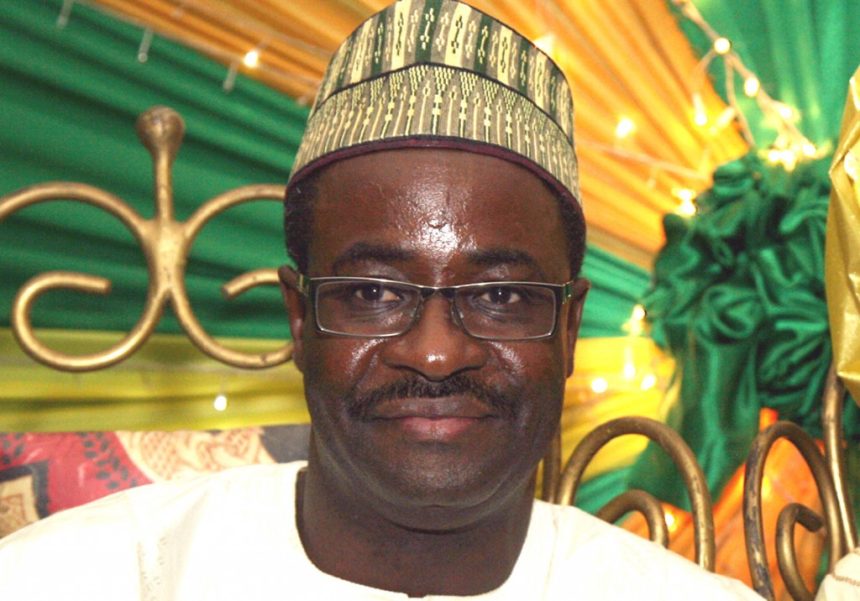
The Director-General of the Budget Office of the Federation, Dr. Tanimu Yakubu, has addressed the controversy surrounding the distribution of federal government projects, stating that the North-West region is the primary beneficiary of President Bola Tinubu’s approvals, not Lagos State.
In a statement titled “Northwest: The Lion’s Share of Tinubu’s Projects,” Dr. Yakubu described the narrative that Lagos State has received N3.9 trillion worth of projects as “misleading and politically motivated.”
He clarified that a detailed breakdown shows that only N1.2 trillion of that amount is for projects exclusive to Lagos, such as airport fencing and local bridge rehabilitation. The remaining N2.7 trillion, he noted, is allocated for major national infrastructure like highways and transport corridors that simply pass through Lagos but serve the entire country.
“By that logic, the Kano–Maiduguri expressway could just as easily be called a Maiduguri-only project. Such sleight of hand ignores a central truth: these are not local trophies. They are the arteries of a national economy,” Dr. Yakubu said.
Dr. Yakubu provided a detailed regional breakdown of project approvals, which he said puts the North-West region at the top. The figures are as follows: North-West N5.97 trillion (over 40% of all approvals); South-South N2.41 trillion; North-Central N1.13 trillion; South-West (excluding Lagos) N604 billion; South-East N407 billion; North-East N400 billion; and Lagos (exclusive projects) N1.2 trillion
According to the DG, these figures confirm that the North-West has the largest share of projects under the current administration.
Dr. Yakubu cautioned against viewing federal projects as “sectional trophies” or “rewards,” stressing that infrastructure like roads, railways, and power plants are national assets designed to connect Nigeria’s economy and people.
“The farmer in Katsina needs a market in Lagos. The trader in Aba depends on goods flowing through Kano. The student in Sokoto requires the national grid as much as her counterpart in Port Harcourt. Federal projects must be understood as national investments designed to connect Nigeria to itself, and ultimately to the world,” he explained.
He also pointed to deliberate investments in the North-West, including the revival of the long-abandoned 255MW Kaduna Power Plant, the ongoing Kaduna–Kano expressway, the Kano–Maiduguri highway, and the Sokoto–Illela corridor as examples of the administration’s commitment to the region. “These are not footnotes,” Dr. Yakubu added. “They are the backbone of a deliberate Northwest-first investment strategy—kilometre by kilometre, megawatt by megawatt.”
Looking ahead, Dr. Yakubu spoke of the forthcoming “Tinubu National Beltway Project,” a large-scale L-shaped corridor that will link Calabar to Maiduguri and then to Sokoto. The project is expected to connect four regions, reduce logistics costs, and stimulate wealth creation.
He also warned against the use of “viral infographics” to create regional divisions, calling such actions “political blackmail” that ignores the broader national vision.
“Lagos remains Nigeria’s commercial hub, rightly upgraded. The Northwest is Nigeria’s electoral fortress, richly rewarded. Every region receives its due, because Tinubu budgets for one economy, one country, one people,” he stated.
Dr. Yakubu concluded by asserting that the administration’s legacy will be judged by tangible results, not by deceptive graphics. “President Bola Ahmed Tinubu has not marginalized the North. He has trusted it, invested in it, and rewarded it. That is the record. That is the fact. That is the truth. And no infographic, however deceptive, can bury it,” he said.