

CBN Launches New FX Manual to Boost Market Liquidity
…Including electronic travel allowance processing
…Increased import advance payments
By Patience Ikpeme
The Central Bank of Nigeria (CBN) has unveiled the fourth edition of its Foreign Exchange (FX) Manual, signaling a major regulatory shift aimed at strengthening the country’s macroeconomic foundations, boosting transparency, and driving market liquidity.
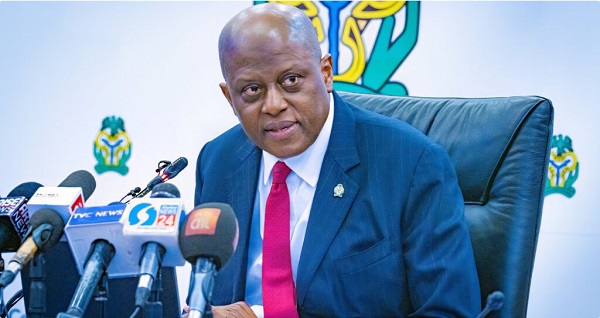
The revised manual, which updates a framework last reviewed in 2018, is scheduled to take effect on June 1, 2026. Central Bank Governor, Mr. Olayemi Cardoso, announced the rollout during an official launch ceremony, noting that the guidelines arrive at a critical juncture for both the domestic and global financial landscapes.
Addressing stakeholders at the launch of manual in Abuja, Mr. Cardoso noted that foreign exchange is more than just a financial instrument, describing it instead as an essential anchor for price stability, investor sentiment, and the cross-border movement of goods and capital. He stated that the integrity of Nigeria’s governance framework is vital to maintaining economic resilience, particularly given the volatility and rapid technological changes currently reshaping global finance.
“Our regulatory systems must continue to evolve in response to both global and domestic economic dynamics,” Mr. Cardoso stated. “That is very important. Not just domestic, but also global. We do not live or operate in isolation. And if you add on to what you are used to doing domestically, and the global environment is changing around you, nobody needs to tell you what the results will be.”
Unlike previous iterations of financial guidelines, the apex bank developed this fourth edition through a collaborative process involving extensive consultation with commercial banks, corporate bodies, and key market participants. Mr. Cardoso pointed out that the document is not a matter of the regulator dictating terms to the market, but rather a joint effort that mirrors the concerns and practical realities of all parties involved.
Detailing the core regulatory revisions, the Deputy Governor of Economic Policy, Mr. Muhammad Abdullahi, explained that the changes collectively seek to modernise Nigeria’s foreign exchange system, support legitimate business activities, improve efficiency, and deepen confidence in the market.
Among the major policy shifts, the CBN has harmonised the disbursement structure for Personal Travel Allowance (PTA) and Business Travel Allowance (BTA) with the revised Bureau De Change guidelines. Under this new arrangement, 75 per cent of PTA and BTA transactions will be processed electronically, leaving only 25 per cent eligible for cash disbursement. Furthermore, the allowable advance payment for imports has been increased from 15 per cent to 30 per cent.
Mr. Abdullahi also disclosed a series of operational adjustments, including the free processing of Form NXP, new provisions tailored for service exports, and specific documentation requirements for tech company remittances. To bolster regional payments and intra-African trade, the manual introduces formal guidelines for the Pan-African Payment and Settlement System (PAPSS).
The revised framework introduces flexibility in domestic foreign currency transactions, now allowing payments for services and fees in foreign currency where receipts are earned in foreign currency. Additionally, the apex bank has introduced Non-Resident Investment Accounts and Non-Resident Ordinary Accounts to enhance market operations.
For educational remittances, the manual permits the payment of tuition fees for undergraduate and postgraduate studies up to a maximum of $25,000 per semester. Mr. Abdullahi noted that holders of export proceeds and ordinary domiciliary accounts will experience easier access to their funds, including seamless transfers between banks for eligible transactions. In a major boost for foreign direct investment, international companies operating in Nigeria’s extractive sector are now permitted full repatriation of their export proceeds.
The apex bank has also removed the mandatory requirement for Form A in specific transactions involving ordinary domiciliary accounts, though commercial banks must still verify the legitimacy of these transactions. Conversely, to maintain systemic stability, the revised framework includes strict provisions designed to stop the front-loading of foreign exchange purchases.
With this shared ownership and modernized structure, however, comes a strict expectation of compliance. The Governor issued a clear warning against market malpractice during the transition period and beyond, stating that because all stakeholders mutually agreed on what constitutes improper conduct, violators will have only themselves to blame for the consequences.
“This manual will take effect on June 1, 2026,” the Governor said. “Ladies and gentlemen, that doesn’t mean that between now and June 1, 2026, there’s room for bad behavior. Don’t say I didn’t tell you.”
To ensure there are no institutional barriers to compliance, the CBN is distributing the manual to all authorized dealers at zero cost. Mr. Cardoso explained that this decision reflects the bank’s firm priority of regulatory adherence over cost recovery, leaving market players with no excuse for ignorance of the new rules.
The ultimate objective of these structural adjustments is the creation of a deeper and more liquid foreign exchange market. The apex bank expects that a self-sustaining, liquid market will correct public misconceptions regarding the nature of national reserves. Mr. Cardoso clarified that foreign reserves are meant to be preserved for long-term stability, rather than serving as a regular funding pool to artificially prop up the daily market.
Recent data indicates that the market is already moving away from its historical dependence on direct central bank interventions. Under the current administration, the Nigerian FX market has transitioned from what was previously a rigid, one-way system into a dynamic environment where investors can enter and exit with confidence.
This structural shift is reflected in the market’s trading volumes. Daily turnover, which averaged around $100 million in the early days of the administration, has risen to an average of between $400 million and $600 million per day. The apex bank, alongside authorized dealers, has set a formal target to push this figure to a consistent $1 billion daily turnover.
“I’m very happy to note that in the course of the past couple of months, we have attained that $1 billion a day in places on a number of occasions,” Mr. Cardoso announced, pointing to the milestone as evidence of sustained progress.
To protect these gains, the CBN plans to introduce a more robust monitoring framework focused on consistency, fairness, and accountability across the entire financial system. The successful operation of the new manual will depend on the continued partnership of authorized dealer banks, corporate organizations, ministries, departments, agencies, exporters, and importers.
In his closing remarks, the Governor expressed appreciation to the Deputy Governor of Economic Policy, the Director of the Trade and Exchange Department, and the broader financial sector for their technical contributions, stating his hope that the manual will serve as a foundation for sustained progress within the Nigerian financial system.