

Dangote Cement Mentors Students at Global Sustainability Competition
By Patience Ikpeme
In a move that bridges industrial expertise with academic ingenuity, Dangote Cement Plc (DCP) recently took center stage at the 2026 Accounting for Sustainability International Case Competition (A4SICC) in Canada.
Serving as a Corporate Supporter, the African cement giant provided critical mentorship to emerging leaders tasked with solving some of the world’s most complex environmental dilemmas.
The A4SICC serves as a premier global platform where student teams design commercially viable solutions for sustainable growth. The 2026 edition required participants to select a company from the World Benchmarking Alliance’s SDG2000 list to build a “business case for nature.” This challenge forced teams to address the paradox of how industries reliant on natural capital can reverse their contribution to biodiversity loss.
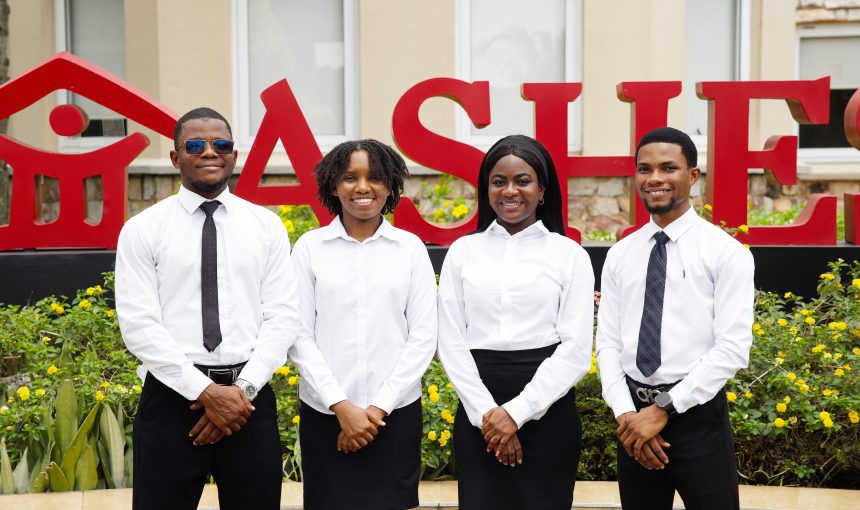
Dangote Cement, a member of the SDG2000 itself, took a hands-on role by coaching REMI Solutions, a team from Ashesi University in Ghana. Under the guidance of Dr. Igazeuma Okoroba, DCP’s Group Head of Sustainability, the students navigated a competitive field of 132 entries from 31 countries to secure a spot in the semi-finals.
The team, featuring Jamiu Olamide Afolayan, Afi Adwoa Asare, Grace Mawuli Uchechi Onwuaha, Edem Korbla Anagbah, and Bartels Ataanga Atindana, focused their research on a high-stakes issue: legacy mine waste, or “tailings.” These waste materials pose significant environmental and safety risks, with historical failures costing global mining firms upwards of US$30 billion in damages and reparations.
The project proposed by REMI Solutions offers a creative circular economy model. Instead of viewing historical tailings as mere liabilities, the team suggested reprocessing them to recover residual minerals. The revenue from these activities would then fund the rehabilitation of degraded land.
Furthermore, the model suggests converting remaining waste into value-added construction materials such as eco-bricks and aggregates. This approach demonstrates how investments aligned with Environmental, Social, and Governance (ESG) standards can protect the planet while remaining financially profitable.
Reflecting on the achievement of the mentored students, the Group Managing Director of Dangote Cement Plc, Arvind Pathak, noted that the collaboration shows the company’s dedication to education, research, and youth-led innovation.
“At Dangote Cement, our decision to support the Accounting for Sustainability International Case Competition is anchored in our belief that the future of sustainable business lies in the hands of informed, innovative, and values-driven young leaders,” Pathak stated.
He remarked that as a company with operations deeply linked to natural capital, there is a clear responsibility to contribute to global dialogues regarding climate resilience and nature-positive growth. “By supporting this platform, we are not only helping students translate academic knowledge into practical solutions, but also reinforcing the importance of embedding environmental, social, and governance principles into core business decision-making,” Pathak added.
The GMD further noted that the concepts birthed during the competition—particularly those involving responsible mining and resource circularity—represent the exact shift in thinking required to solve modern environmental crises. “We are excited to play a mentoring role that bridges industry experience with youthful innovation,” Pathak concluded. “We remain committed to nurturing solutions that create shared value for businesses, communities, and the environment.”
As global attention turns toward responsible resource recovery, the success of the REMI Solutions team in Toronto serves as a testament to the potential of corporate-academic partnerships in fostering a sustainable industrial future for Africa and the world.