

DBN Approves N8.5bn Dividend as Cumulative MSME Funding Hits N1.4tr
By Patience Ikpeme

The Development Bank of Nigeria (DBN) has cleared a total dividend payout of N8.5 billion for the 2025 financial year, following a period of aggressive credit expansion that saw its cumulative interventions in the small business ecosystem cross the N1.4 trillion mark.
At the bank’s 9th Annual General Meeting held in Abuja on Thursday, shareholders moved to approve a dividend of N85 per share. This distribution aligns with the institution’s standing policy, established during its 6th AGM, which caps dividend payouts at 25 percent of earnings to ensure long-term financial sustainability while rewarding key investors, including the Federal Government through the Ministry of Finance Incorporated (MoFI) and the Nigeria Sovereign Investment Authority (NSIA).
The bank’s financial scorecard for the 2025 window indicates that over N300 billion was channeled to Micro, Small, and Medium Enterprises (MSMEs) within the single calendar year. These funds reached more than 180,000 beneficiaries, many of whom are micro-entrepreneurs accessing credit via a network of partner microfinance and commercial banks.
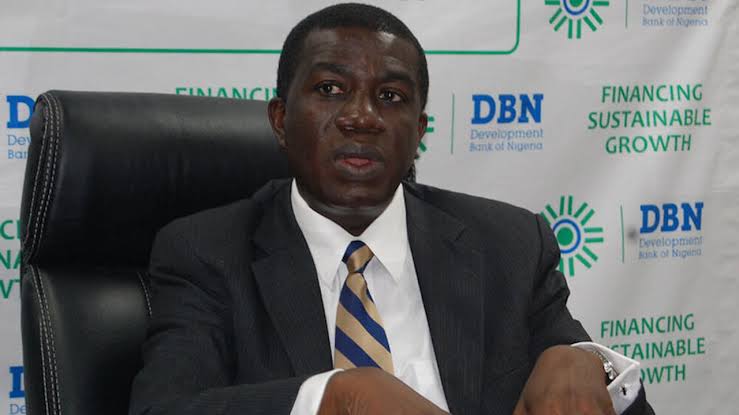
Managing Director and Chief Executive Officer, Dr. Tony Okpanachi, stated that the bank’s primary focus remains the measurable impact on the Nigerian economy rather than just the scale of its balance sheet. “DBN has cumulatively disbursed over N1.4 trillion in loans through financial institutions to MSMEs since inception,” Okpanachi said, noting that these capital injections have supported the creation of more than 1.6 million jobs across the federation.
Beyond direct funding, the bank scaled its technical assistance operations significantly in 2025. Records presented at the meeting showed that more than 48,000 MSMEs received specialized training on business best practices and credit readiness. Okpanachi explained that this capacity-building framework is essential for helping businesses navigate the requirements of partner financial institutions, who bear the credit risk and ultimately determine the lending interest rates.
Reflecting on the bank’s trajectory, Independent Non-Executive Director, Kyari Bukar, pointed out that the institution has achieved significant growth within its first decade of operations. He confirmed that the N85 per share dividend translates to a N8.5 billion total commitment, a feat he credited to robust corporate governance and management expertise.
“The bank’s impact on financial inclusion and economic development is more important than its financial performance,” Bukar said, while clarifying that while the bank has lent over N1 trillion cumulatively through intermediaries, it has also recently commenced direct lending operations to further broaden its reach.
Despite the persistent financing gap within the MSME sector, the bank’s leadership expressed optimism regarding the 2026 outlook. Bukar indicated that DBN is positioned to deliver value even amidst global geopolitical tensions and domestic economic uncertainties. He noted that the strategy for the coming year involves deepening financial inclusion and maintaining a strict focus on training entrepreneurs before capital is deployed to ensure the effective management of funds.
The board maintained that the bank will continue to prioritize monitoring and evaluation post-disbursement to ensure that the N1.4 trillion cumulative spend continues to translate into tangible economic growth and business resilience across Nigeria’s industrial hubs.