MPC Resets MPR to 23%, Changes Interest-Rate Corridor
By Patience Ikpeme

The Monetary Policy Committee (MPC) of the Central Bank of Nigeria (CBN) on Tuesday reset the Monetary Policy Rate (MPR) to 23 per cent and changed the interest-rate corridor around the benchmark rate.
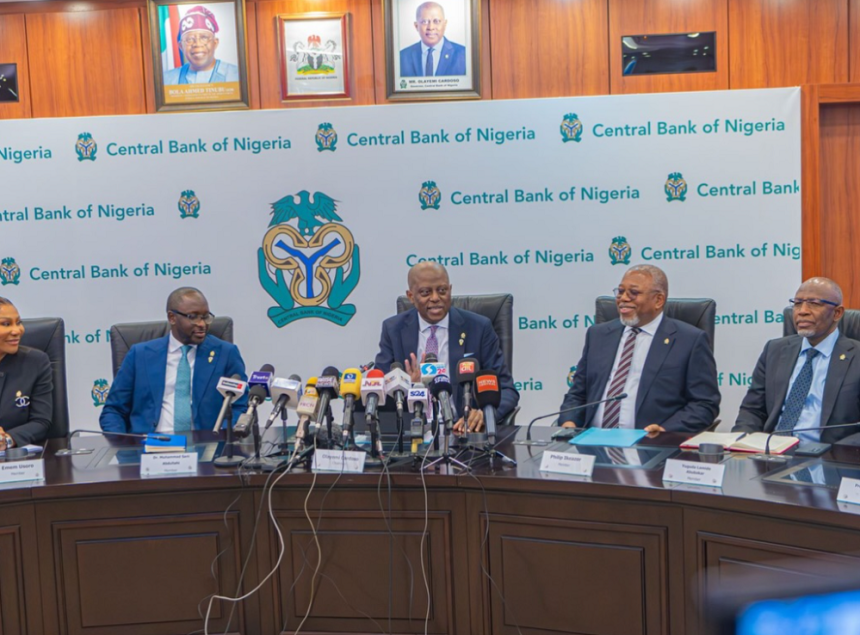
CBN Governor and Chairman of the MPC, Olayemi Cardoso, announced the decisions while presenting the communiqué at the end of the committee’s 307th meeting held on Monday and Tuesday in Abuja to journalists.
The MPC he said also retained the Cash Reserve Requirement (CRR) for Deposit Money Banks at 45 per cent, Merchant Banks at 16 per cent and non-Treasury Single Account (TSA) public sector deposits at 75 per cent.
The committee changed the Standing Facilities Corridor to plus 50 and minus 300 basis points around the MPR.
The decisions represent a major adjustment to the way the CBN implements monetary policy, although the committee said the changes should not be interpreted as a shift in the underlying direction of monetary policy.
The MPC said the reset was mainly aimed at making the MPR more effective as the main signal for interest rates in the economy.
According to the committee, the difference between the MPR and actual market interest rates had weakened the transmission of monetary policy.
The CBN Governor said the apex bank’s ongoing changes to the monetary policy implementation framework, including the use of the Nigerian Overnight Financing Rate (NOFR) as a transaction-based operating benchmark, had improved transparency in money-market operations.
The committee therefore decided that the MPR and its operating corridor needed to be brought more closely in line with prevailing market conditions.
Cardoso said the adjustment was “an operational realignment” intended to strengthen policy transmission and restore the MPR as the principal signal of monetary policy. He also said the move would support Nigeria’s transition to an inflation-targeting framework.
The Governor stressed that the corridor adjustment “does not constitute a change in the current monetary policy stance”, but is intended to improve the effectiveness of the existing monetary policy framework.
The decision came against the background of improving inflation figures, stronger economic growth and a substantial increase in Nigeria’s external reserves.
Inflation continued to ease in August, with headline inflation falling slightly from 15.43 per cent in July to 15.39 per cent. Food inflation recorded a larger decline, falling from 20.31 per cent to 19.57 per cent during the period. Core inflation also dropped from 14.97 per cent in July to 13.29 per cent in August.
The MPC said the 12-month moving average of headline inflation had now declined for 20 consecutive months, falling from 16.89 per cent in July to 16.30 per cent in August. Month-on-month headline inflation also slowed considerably, from 1.57 per cent in July to 0.71 per cent in August.
The committee linked the improvement to the effects of previous monetary tightening, relative stability in the foreign exchange market and improved inflation expectations.
Cardoso also said the Presidential Initiative on National Affordable CNG Transit Programme was expected to reduce transportation costs and support the decline in inflationary pressures.
The inflation trend came alongside stronger economic growth. Nigeria’s real Gross Domestic Product grew by 4.43 per cent in the second quarter of 2026, compared with 3.89 per cent in the first quarter.
The non-oil sector grew by 4.31 per cent, up from 3.94 per cent in the previous quarter. The CBN Governor said information and communications technology, crop production, real estate, livestock, financial services and trade were among the activities supporting the expansion.
The oil sector also recorded a significant improvement, growing by 7.31 per cent in the second quarter compared with 2.57 per cent in the first quarter.
The committee attributed the stronger oil-sector performance to increased production and investment.
Business activity also remained in expansion territory, with the composite Purchasing Managers’ Index rising from 51.1 points in July to 52.7 points in August.
The external sector provided another important support for the MPC’s decision. The committee said Nigeria’s balance of payments surplus increased from $2.38 billion in the first quarter to $3.51 billion in the second quarter. The current account surplus also rose by 67.92 per cent, from $4.49 billion to $7.54 billion during the same period.
Nigeria’s gross external reserves stood at $55.25 billion as of September 18, according to the CBN. The CBN Governor described the reserves as the highest level in 18 years and said they were sufficient to finance approximately 11.3 months of imports of goods and services.
The committee noted that the stronger external position, together with moderating inflation and improved economic activity, had created sufficient room for the recalibration of the monetary policy framework.
The MPC also took note of the recent agreement between the Federal Government and the CBN on closer coordination of fiscal and monetary policies.
The Federal Ministry of Finance and the CBN recently signed a Memorandum of Understanding on fiscal-monetary coordination. The committee said the agreement would provide a structured framework for policy harmonisation aimed at achieving low and stable inflation.
The MPC also assessed the banking sector following the recapitalisation exercise. It said the programme had strengthened banks’ capital buffers and resilience and increased their capacity to finance long-term projects in critical sectors of the economy.
However, the committee noted that the domestic economy still faced risks from developments outside Nigeria. It said global economic growth was projected to slow to 3.0 per cent in 2026 from 3.5 per cent in 2025, partly because of the effects of the Middle East conflict, continuing uncertainty around trade policies and limited fiscal space.
The CBN Governor warned that global inflation pressures could increase because of supply-chain disruptions, elevated crude oil and other commodity prices, growing trade fragmentation and renewed geopolitical tensions.
For Nigeria, the MPC expects economic growth to remain resilient during the rest of the year. It expects increased crude oil production, stronger agricultural activity and continued expansion in other business activities to support output.
The committee also expects inflation to continue moderating in the short to medium term. It based this outlook on foreign exchange stability, the delayed effect of earlier monetary tightening and expectations of improved food supplies as the harvest season progresses.
The MPC, however, identified prolonged geopolitical tensions in the Middle East and election-related spending as possible sources of additional pressure on prices.
At the end of the meeting, the committee said it would continue to assess the effectiveness of the new interest-rate corridor to ensure that monetary policy decisions are transmitted more effectively through the financial system.