

FG Calls for Citizen Action as 70m Lack Clean Water
By Patience Ikpeme

The Federal Government has called for the active participation of all citizens, state governments, and strategic partners to bridge the significant clean water gap, which currently affects over 70 million Nigerians.
Minister of Finance and Coordinating Minister for the Economy, Mr. Wale Edun, made the statement in Abuja on Wednesday during the public launch of the Lokoja Dialogue, a forum focused on addressing the nation’s persistent water crisis.
According to Minister Edun, the immense scale of the crisis means that government action alone is insufficient. While the problem is national, its effects are “local and deeply personal,” requiring a collaborative response.
The Finance Minister stressed the necessity of grassroots involvement in tackling the issue.
“At the community level, action must be taken,” Mr. Edun stated. “People must be incentivised, mobilized, empowered to make their contribution— including to this water crisis.”
He observed that water is fundamental to life, asserting that the current administration’s reforms aim squarely at improving citizens’ lives.
“Water is life, and the reforms of the current government are all about improving lives. Gaps remain, despite the progress made. We’ve heard it earlier: over 70 million Nigerians still lack clean drinking water,” he disclosed.
Mr. Edun also pointed out the varied nature of the crisis across regions. “In the South, in the Delta — I was on the board of the Trust Fund — and the water there had benzene in it. That was their problem. In the North, as we know, with the drying up, desertification, and scarcity.”
He acknowledged the different sociopolitical aspects: “So there’s an abundance of water politics in the South. In the North, scarcity of water. But at the same time, these issues affect real families and vulnerable communities.”
Mr. Edun also noted that state governments have a major role to play in the solution, given their increased financial capacity under the current administration.
“The States have their role to play. Under President Tinubu, they have more funds than they’ve ever had. So they are more empowered to contribute,” he added.
Recognizing the foundational importance of water, the Federal Government is aware that it “is the foundation of public health, food security, productivity, and national stability.”
The Minister believes the solution rests on a unified approach, declaring, “to work together to find the solutions to the problems. Let’s combine clear policy direction, strong partnerships, and innovative and sustainable financing mechanisms.”
Mr. Edun further tied the solution to economic resources, noting, “Money solves all things. And a lot of the people convened and gathered here today — a big part is finding financing to implement the solutions we come up with.”
This effort, he concluded, is essential “to have resilience, inclusivity as we grow the economy, and give people the dignity of having enough water to take care of themselves, to nourish themselves, and to ensure that no community is left behind.”
The First Lady, Mrs. Remi Tinubu, represented by the wife of the Vice President, Hajiya Nana Shettima, also spoke at the event, underscoring the daily struggles of Nigerian families.
“Across our country, families seek better access to clean water, food, and energy. In some places, farmlands are dry, while in others, floods wash away fertile soils and harvests,” she observed. She highlighted the vulnerability of certain demographics: “And where the harvest fails, it is women and children who are most at risk.”
Mrs. Tinubu expressed delight that the Lokoja Dialogue “is aimed at addressing these issues in our communities. This initiative exists to connect communities, define our agendas, policy, partnership, and investment, to cultivate and thrive sustainable water solutions, and recycle our discarding and climate-driven poverty.”
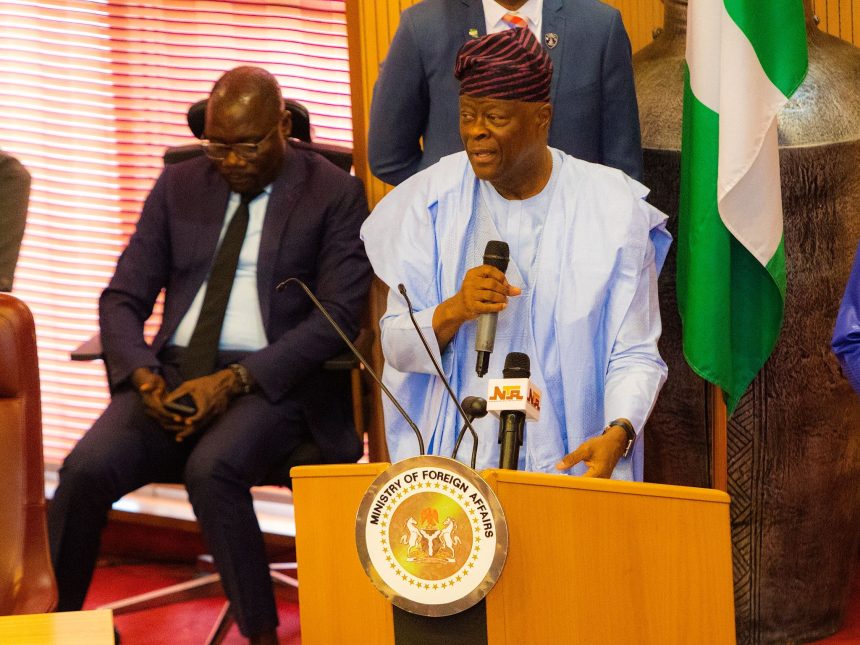
Also speaking at the launch, the Minister of Foreign Affairs, Ambassador Yusuf Maitama Tuggar, provided a historical perspective, linking water to the continent’s development.
“I would like to say that the history of Africa, of our continent is inextricably tied to the history of water and water systems,” Ambassador Tuggar remarked. He explained that movements of people over centuries have been dictated by the search for water and better land, making debates about who is indigenous “really a distraction.”
Ambassador Tuggar connected this history to current government priorities, specifically the African Development Programme, noting that the Tinubu Administration places food security as its number one priority. “And that’s, of course, also premised on the water, how we use water, and how we manage it,” he noted.
He concluded by celebrating Nigeria’s geographical fortune, stating, “We are lucky to be blessed with water, because Nigeria itself was born out of the confluence of two great African rivers, and even before the maps were drawn, the people that lived around those two rivers traded with each other, they intermarried, they lived together, that coexistence has always been there.”