

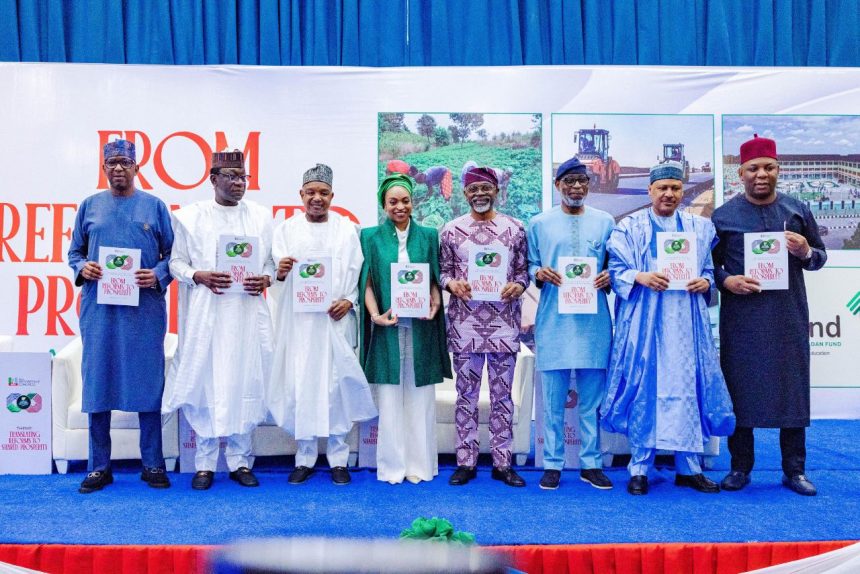
Bagudu: Tinubu’s Hard Times Over, Prosperity Ahead for Nigerians
By Patience Ikpeme

The Minister of Budget and Economic Planning, Senator Abubakar Bagudu, has told Nigerians that the painful period that came with President Bola Tinubu’s economic reforms has ended and that better days are now certain.
Bagudu spoke in Abuja on Monday at the media presentation of the All Progressives Congress (APC) manifesto for the 2027 presidential election. The document is titled “From Reforms to Prosperity” and sets out how the Tinubu administration plans to turn its reforms into a better life for citizens.
According to the minister, the reforms have made private businesses more confident, brought in new investment and prepared the ground for prosperity that reaches everyone. To show how far things have come, he took his audience back to 2015, when several state governors were said to be struggling to pay workers’ salaries. He contrasted that with today’s larger federal allocations, steady economic growth and stronger investor confidence.
Bagudu added, however, that the true test of the reforms is what they do for ordinary people, especially hardworking citizens and poor households. He said the next four years of the President’s tenure would be devoted to making sure Nigerians feel the benefits in their daily lives.
Chief of Staff to the President, Femi Gbajabiamila, described the manifesto as a “social contract” between the government and the people. He said its promises must be measurable so that citizens can check whether they are kept. He admitted that ending the fuel subsidy and reforming the foreign exchange system put pressure on households, but said government must ensure the gains lead to a better quality of life.
Gbajabiamila pointed to the Nigerian Education Loan Fund (NELFUND), the tax reforms and the Electricity Act as steps already taken. Among the new promises are cutting the number of children out of school by half by 2031, supplying seven million more electricity meters and widening access to health insurance. He said the party and government can be judged against these clear targets, and called for continued talks with communities.
The Minister of Solid Minerals Development, Dr Dele Alake, said the reforms were creating room to diversify the economy, especially through minerals. He said the sector earned ₦6 billion in 2023, ₦38 billion in 2024 and ₦70 billion in 2025. In the first nine months of 2026 alone, it earned more than ₦101 billion. He said this shows the sector is becoming a real source of national revenue, factory development and jobs, which can help reduce Nigeria’s dependence on oil. He added that the 2027 manifesto would build on current efforts to unlock the country’s economic potential.
The Minister of Information and National Orientation said the government’s policies are meant to benefit more than the political and economic elite. He listed new infrastructure, safer travel along the Abuja–Kaduna–Kano corridor, and student loans through NELFUND, which he said have reached about 1.6 million people. He also cited Nigeria’s removal from the Financial Action Task Force (FATF) grey list, better economic ratings and improved key economic indicators as signs of progress.
He urged journalists to report fairly and responsibly, covering verifiable achievements alongside challenges, so that citizens can understand government policies and their results.