

Dangote Cement Launches Multi-Million Naira Empowerment Schemes in Benue
By Patience Ikpeme

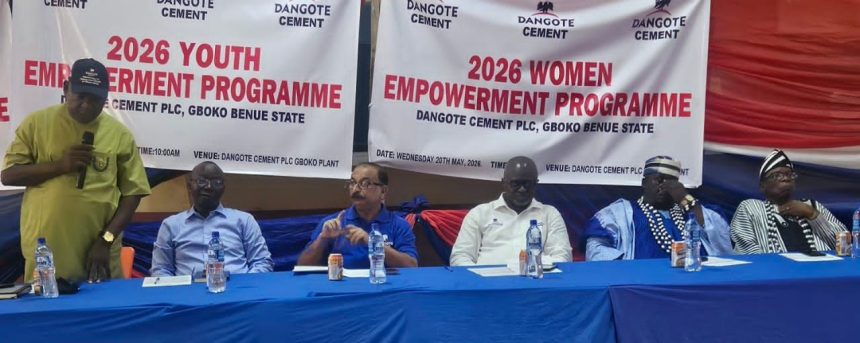
Dangote Cement Plc has launched three major empowerment initiatives targeted at boosting economic independence for women, youth, and farmers across six of its host communities in Benue State’s Gboko Local Government Area.
The multi-million-naira intervention is designed to help local operators scale up their businesses, optimize agricultural yields, and equip young people with modern technical skill sets. The targeted areas include Tse-Kucha, Quarry, Amua, Mbazembe, Mbatur, and Pass Brothers.
Under the specific roll-out of the scheme, cash grants will go to 150 local women to expand their trading enterprises, while 52 farmers are set to receive essential agricultural inputs. Additionally, 30 youths will be admitted into specialized vocational training paths run by the Industrial Training Fund (ITF).
The Minister of Solid Minerals Development, Dr. Dele Alake, expressed satisfaction with the development, praising the manufacturing giant for its steady investments in community growth. Speaking through his representative, Mrs. Usman Adijatu, the minister said the federal authorities appreciate the manufacturer’s corporate footprint in Benue State and the wider Nigerian economy.
“The company’s community-focused interventions complement the government’s efforts to promote inclusive growth, reduce poverty and create sustainable livelihoods in mining and industrial host communities,” Alake said.
The minister also called on the recipients to approach the resources with a business mindset, noting that the inputs, training, and capital should serve as a launchpad for long-term financial self-sufficiency.
The Head of Social Performance for Pan-African Operations at Dangote Cement Plc, Mr. Wakeel Olayiwola, spoke on the operational framework of the corporate social responsibility initiatives. He explained that these projects are built on mutual agreements between the company, state authorities, and host neighborhoods via the Community Development Agreement (CDA) framework.
Olayiwola thanked the host communities for fostering a peaceful environment that allows these projects to succeed, while praising the CDA Consultative Committee for running an objective selection process to reach the most vulnerable residents.
Providing further operational context, the Plant Director for the Gboko facility, Engr. Abhijit Dutta, stated that the programs reflect a core company philosophy: corporate success must translate into tangible social advancement for the people nearby. “Our host communities are not just neighbours; they are valued partners in progress,” Dutta said.
According to the Plant Director, this current phase is part of a structured five-year CDA that took effect in 2025. The ongoing agreement seeks to distribute institutional support evenly across all six communities to fight poverty and build local economic resilience.
Dutta also shared that the enterprise is finalising a new scholarship package for local students to be unveiled in the near future. He stated that the President and Chief Executive of the Dangote Group, Aliko Dangote, maintains a personal interest in elevating the living standards of the company’s host populations.
The company disclosed that over 230 individuals were empowered through identical tracks last year. Management expects to maintain this momentum for the lifespan of the current CDA, confirming that several infrastructural and social projects are actively moving forward with completions slated before the end of the year.
Dr. Johnson Kor, the Head of Social Performance at Dangote Cement Plc, added that the firm maintains a wide array of civic programs focused entirely on lifting the socio-economic status of its neighbors.
The paramount ruler of the Gboko territories, the Ter Gboko, HRH Gabriel Shosum, welcomed the development, describing the company’s interventions as timely and highly beneficial for his subjects.
The traditional ruler pledged that the communities would continue to offer full cooperation and act as protectors of the company’s industrial interests in the region. He challenged his people to protect the peace, pointing out that internal stability is the only way to attract further investments and corporate goodwill from the plant.