
Nothing Must Happen to Dangote Refinery, VP Shettima Warns PENGASSAN
By Patience Ikpeme

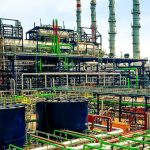
Vice President Senator Kashim Shettima, representing President Bola Ahmed Tinubu, issued a strong caution on Monday regarding the trade union controversy involving the Dangote Refinery and the Petroleum and Natural Gas Senior Staff Association of Nigeria (PENGASSAN), stating that nothing must happen to the $20 billion facility.
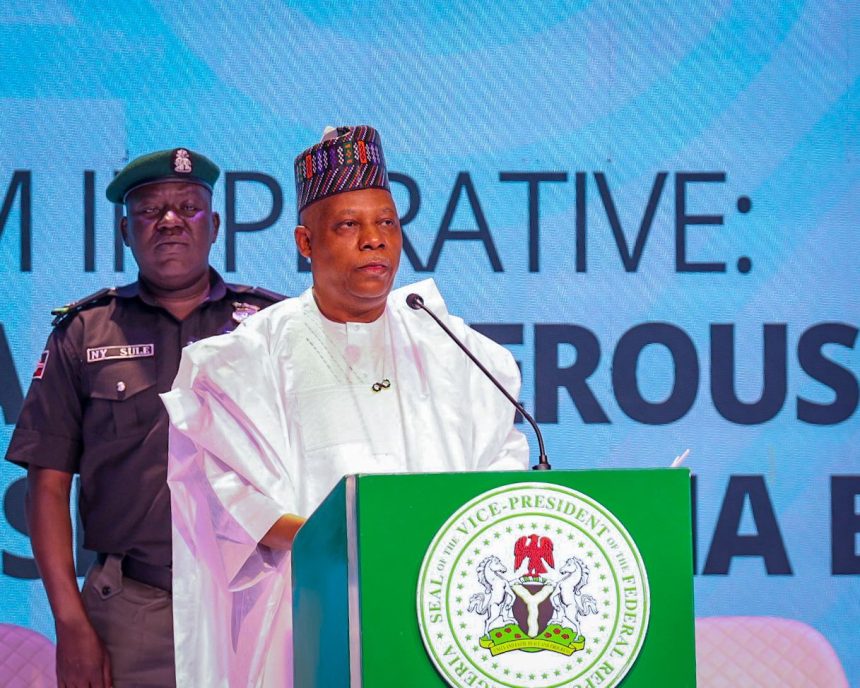
Speaking at the 31st Nigerian Economic Summit (NES #31) in Abuja, Senator Shettima warned that Aliko Dangote, the owner of the refinery, is more than an individual.
“He’s an institution and he’s the leading light in Nigeria’s economic development, and how we treat this gentleman will determine how outsiders will judge us,” the Vice President said.
The Vice President stressed the refinery’s crucial financial obligations that necessitate its continuous operation. “This is a refinery that was financed, through a combination of equity investment, through debt finance, and loans from local and foreign banks. The refinery has to function to service the debt. And we cannot hold the whole nation to ransom, because of issues that we can amicably settle across the table.”
Senator Shettima contrasted Dangote’s investment choice with potential alternatives, arguing the nation owes it to the future to protect the investment.
“If he had invested $10 billion in Microsoft, in Amazon, in Google, probably he might be worth $70 to $80 billion by now. But he opted to invest in this country, and we owe it to future generations. To generously promote, preserve, and protect the interests of this very Nigerian.”
He called for responsibility from organized labor and the private sector. “It’s not about holding the gold medal for ransom, because of its high level of history, Nigeria is greater than PENGASSAN, Nigeria is greater than each and every one of us,” he stated.
The government tasked the Nigerian Economic Summit Group (NESG) with looking beyond singular interests, stating that the government expects far-reaching recommendations from the NESG to address the dispute while maintaining industrial harmony for the entire population.
The Vice President clarified the administration’s stance, noting, “This is off-the-cuff remarks, but I believe it reflects the true position of President Bola Ahmed Tinubu. It reflects the true position of the Nigerian people.”
Addressing the state of the economy, the Vice President articulated the government’s three-pronged strategy to achieve stability and growth. “As Nigerians, we are not condemned to low growth, high costs, and low trust. We will stabilize. We will industrialize. We will humanize our economy. We will stabilize prices and currency. And we will industrialize through power, logistics, and technology. We will humanize governance so that every citizen feels respected and served.”
He announced that the initial framework for the second five-year National Development Plan (NDP) 2026-2030 sets an aspirational target of achieving a GDP of US$1 trillion by 2030. This ambitious goal requires an 8.78% average annual real GDP growth.
The Vice President pointed to several ongoing government initiatives: A N200 billion intervention fund to support micro, small, and medium enterprises (MSMEs) and manufacturers; grants, loans, and equity investments of up to $100,000 for young Nigerian entrepreneurs; major tax reforms (including the Nigeria Tax Administration Act and the Nigeria Revenue Service Establishment Act) designed to protect low-income earners, simplify compliance, and boost domestic revenue; 440 ongoing road projects covering over 2,700 kilometers of superhighways to improve connectivity; and the Renewal Hope Ward-Based Development Program, a people-centered initiative targeting all 8,809 wards to map and unlock local economic potential.
The Vice President concluded by seeking collaboration: “Our ticket to achieving inclusive and lasting prosperity is our series of sound policies, strong partnerships, and the commitment of the private sector.”
The Chairman of the NESG, Mr. Olaniyi Yusuf, speaking under the theme ‘From Stabilisation to Sustained Transformation’, laid out seven critical priorities needed to consolidate economic gains.
“The challenge before us is to move decisively into the consolidation phase, embedding reforms in ways that drive jobs, growth, and inclusion, while simultaneously laying the foundations for long-term transformation that secures prosperity for every Nigerian,” Mr. Yusuf said.
He identified the priorities as: building industries anchored on local value chains, agro-processing, and light manufacturing, with MSMEs needing access to affordable finance and stable power; prioritizing reliable power, efficient logistics, and digital connectivity; signaling that Nigeria is open and predictable, with a focus on policy predictability and faster dispute resolution.
Other priorities are: strengthening revenue, prudently managing debt, and aligning fiscal and monetary policy; ensuring growth is felt in households through expanded safety nets, education, healthcare, and jobs; making reforms system-based, not personality-dependent, and ensuring regulators and labor unions focus on promoting a positive investment climate. He warned: **“A narrow focus on IGR at the expense of business growth will kill the goose that lays the golden eggs. As we all know, dead businesses don’t employ workers, they don’t pay salaries, and they don’t pay taxes”; and treating security as an enabler of reform, vital for restoring confidence and unlocking productivity.