
Nigeria Demands Equity in Global Shift to Hydrogen Economy
By Patience Ikpeme

Nigeria has called on the United Nations to champion a global hydrogen economy built on the foundations of equity and inclusivity, warning that the world must not repeat the historical mistakes of lopsided industrial development.
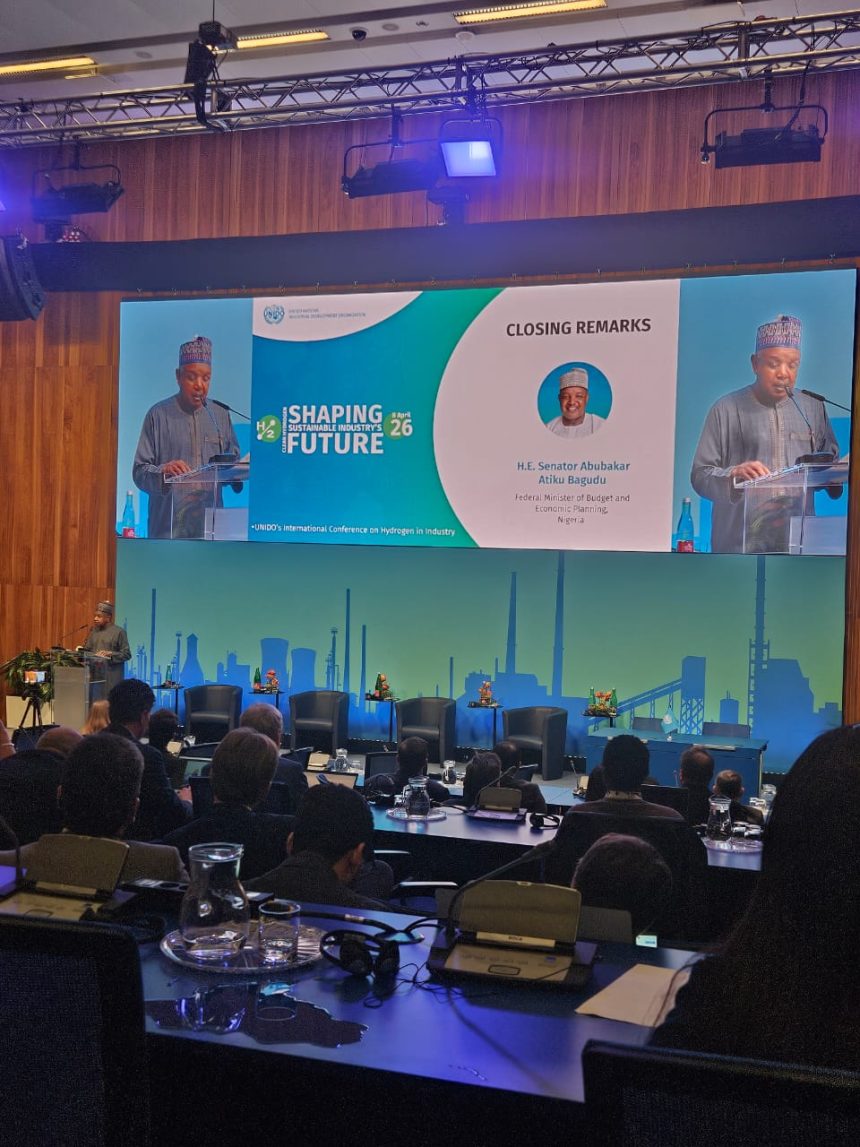
Speaking at the conclusion of the “Clean Hydrogen: Shaping Sustainable Industry’s Future” conference in Vienna on Wednesday, the Minister of Budget and Economic Planning, Senator Abubakar Bagudu, stated that the transition to cleaner energy must be a collective journey where no region is left behind. The event, organized by the United Nations Industrial Development Organisation (UNIDO), served as a high-level platform for discussing the role of hydrogen in global decarbonization.
In a direct address to the international body, Senator Bagudu argued that for hydrogen to be a true success, the UN must actively work to prevent a lopsided economic structure. He noted that previous global industrial shifts often saw a concentration of wealth and technology in a few nations while others were restricted to providing resources.
“We must ensure that the emerging hydrogen economy does not replicate past inequalities, where value creation is concentrated in a few regions while others remain mere suppliers of raw potential,” Bagudu told the assembly.
He described the shift toward hydrogen as a “historic opportunity” for developing nations to move from the periphery of global energy systems to the center. To achieve this, the Minister requested a global commitment to accelerated regulatory frameworks and policies that would drive investment and ensure that technological advancements lead to shared prosperity.
Detailing Nigeria’s domestic strategy, the Minister presented the country’s National Hydrogen Policy as a cornerstone of President Bola Ahmed Tinubu’s broader economic and energy agenda. He explained that Nigeria is pursuing a dual-track approach, utilizing its vast natural gas reserves to develop blue hydrogen while simultaneously laying the groundwork for green hydrogen through renewable energy expansion.
“Under the current Administration of His Excellency, President Bola Ahmed Tinubu, GCFR, our approach is both pragmatic and forward-looking in leveraging natural gas to advance blue hydrogen through our ‘Decade of Gas’ initiative, while scaling renewable energy to unlock long-term green hydrogen opportunities,” Bagudu said.
He further noted that the Nigerian government has moved beyond theoretical frameworks into concrete action. This includes large-scale investment drives and the integration of hydrogen technology into existing projects, such as the commercialization of gas flaring and the use of climate funds to bridge financing gaps.
While acknowledging that countries in the Global South possess the renewable resources needed to lead the green energy revolution, Bagudu cautioned that natural wealth alone is insufficient. He stated that turning this potential into reality requires “genuine international cooperation” and clear demand signals from the Global North to justify large-scale infrastructure investments.
The Minister urged UNIDO to continue its vital work as a facilitator between the public and private sectors, particularly in helping developing nations access fair financing and technical knowledge.
“The future of clean hydrogen is not predetermined but will be shaped by the choices we make, the partnerships we forge, and the urgency with which we act,” Bagudu concluded. He called for a global shift toward projects that are not only “innovative but inclusive” and a future that is “not only global but truly shared.”