

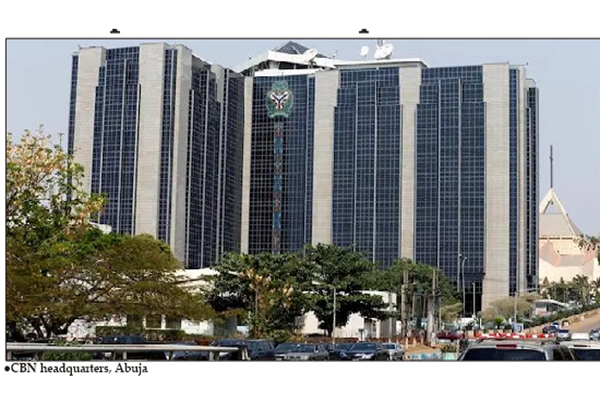
Investor Confidence Drives Reserves to $46.7 Billion, Says CBN
By Patience Ikpeme

Sustained inflows and renewed investor interest have propelled Nigeria’s foreign reserves to $46.7 billion as of November 14, 2025, providing a robust 10.3 months of cover for imports of goods and services.
This disclosure was made by Mr. Muhammad Sani Abdullahi, Deputy Governor, Economic Policy Directorate (DG, EP), who represented the Central Bank of Nigeria (CBN) Governor, Mr. Olayemi Cardoso, at a colloquium marking the 20th Anniversary of the CBN’s Monetary Policy Department (MPD).
Speaking on the significant accretion, Mr. Abdullahi quoted the Governor, stating, “This reflects investor confidence in our policies leading to improved oil receipts, stronger balance of payments, and renewed foreign portfolio inflows.”
This rising confidence has coincided with the top three international ratings agencies upgrading Nigeria, with the most recent being S&P Global Ratings, which revised the nation’s sovereign outlook from stable to positive. Mr. Abdullahi said this recognition “reflects the impact of sustained reforms that have placed our economy on a more resilient path.”
Complementing this positive momentum, Nigeria’s recent removal from the Financial Action Task Force (FATF) Grey List marks another major achievement in restoring global confidence. This, the CBN Governor’s representative noted, “demonstrates our full alignment with global standards on anti-money laundering and counter-terrorism financing, further unlocking opportunities for foreign investment and trade finance.”
According to the Governor, the combination of these measures “have created a more competitive currency, improved trade balances, and strengthened the foundation for inclusive development.”
The event centered on the role of the MPD, which Mr. Abdullahi described as occupying “a central role in the Bank’s policy architecture.” He noted that its work “underpins the formulation and coordination of monetary policy, which is the cornerstone of macroeconomic stability,” having provided robust technical support to the Monetary Policy Committee (MPC) and the Monetary Policy Technical Committee (MPTC).
Looking ahead, a significant task is the successful transition to a full inflation-targeting regime. “This is not merely a technical adjustment; it is a strategic imperative for anchoring expectations and sustaining price stability,” Mr. Abdullahi conveyed from the Governor’s address. “Inflation targeting will enhance transparency, improve credibility, and strengthen the effectiveness of monetary policy transmission.”
The Governor urged the department’s members to “remember that our ultimate goal extends beyond technical achievements. It is about building a resilient economy that fosters growth, creates jobs, and delivers shared prosperity. Monetary policy must remain credible, coherent, and adaptive to changing realities.” He concluded his charge, saying, “the journey ahead requires even greater commitment, creativity, and collaboration. Continue to innovate, continue to strengthen coordination, and continue to uphold the highest standards of professionalism.”
Dr. Victor Oboh, Director of the Monetary Policy Department, in his address, detailed the department’s evolution, noting that it has grown from a fledgling structure into “a strategic net center of the bank’s policy architecture.” The department has consistently supported top management, producing experts who have served in advisory and directorial capacities to successive governors.
Dr. Oboh stated that the department has “supported the Monetary Policy Committee with cutting edge research, Macroeconomic Analysis, ensuring that decisions are grounded in evidence and aligned with global best practices.” He highlighted its role “in shaping Nigeria’s transition from direct control to a market based monetary policy regime,” from the inventory policy rate in 2006 to the strengthening of the policy communication framework.
He explained that the department’s contributions endured through “critical episodes and challenging periods such as the global financial crisis, commodity price shocks and the COVID-19 pandemic,” demonstrating its resilience. Building on lessons from these crises, the inflation targeting framework has emerged as the favored approach.
Dr. Oboh confirmed the bank’s decisive steps toward operationalizing this framework, stating, “today, we stand at an advanced stage of this phase migration, integrating elements of inflation targeting to our hybrid framework, While laying the foundation for a credible, forward looking regime that will restore price stability and further strengthen investor confidence.” He also cited measurable progress, including “moderating inflation, relative stability in the foreign exchange market, narrowing of exchange rate disparities and a rise in external reserve to over 46 billion as of November 14, 2025.”
Dr. Oboh concluded that the anniversary, themed ‘Monetary Policy in Nigeria, Past, Present and Future,’ is a moment to “build on these achievements and embrace the innovation that will define the next era of monetary policy,” which will include navigating challenges like global economic fragmentation, digital currencies like the stablecoin, and climate related financial risk.