

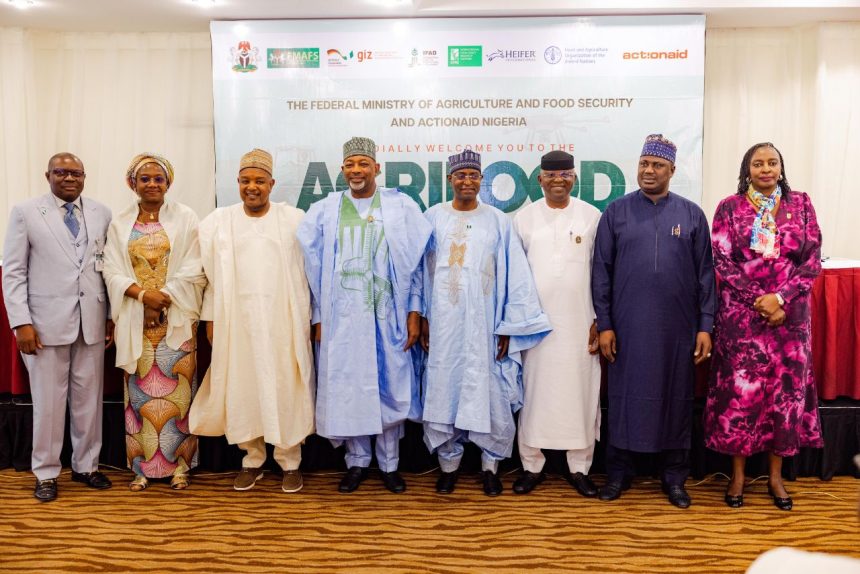
FG Outlines New Strategy to Transform Agrifood System
By Patience Ikpeme

The Federal Government has declared its intent to overhaul Nigeria’s agrifood structure through deeper inter-agency partnerships, institutional restructuring, technology-driven practices, and expanded private investment aimed at ensuring lasting food security and alleviating poverty across the country.
This commitment was detailed by the Minister of Budget and Economic Planning, Senator Abubakar Atiku Bagudu, during his address at the 2nd Biannual Meeting of the Agrifood Systems Working Group (ASWG), organized in Abuja by the Federal Ministry of Agriculture and Food Security.
During the gathering, Bagudu commended the Minister of Agriculture and Food Security, Senator Abubakar Kyari, for directing the national execution of the Comprehensive Africa Agriculture Development Programme (CAADP) 2026–2035. He pointed out that while the African Union’s overarching strategy spans a ten-year horizon starting in 2026, President Bola Ahmed Tinubu has established a tighter national timeline to pull citizens out of poverty by 2030 through targeted economic growth, food stability, and enhanced rural livelihoods.
The minister noted that the nation’s constitution places food security at the heart of development, framing agricultural growth as a shared duty split across federal, state, and local governments under Nigeria’s cooperative federalism.
In detailing the expanse of the domestic farming landscape, Bagudu pointed to the presence of more than 42 million agricultural households. He characterized these smallholder family operations as the vital core of the nation’s food network, explaining that boosting their productivity directly impacts market surpluses, income levels, and broader economic stability.
“The success of Nigeria’s food system depends on empowering our millions of farming households with the support, technology, financing, and market opportunities they need to produce more efficiently and improve their incomes,” Bagudu stated.
He explained that President Tinubu’s Renewed Hope Agenda treats agriculture as a pillar of national policy, citing targeted institutional steps such as the creation of the Federal Ministry of Livestock Development and the shift of fisheries management to the Ministry of Marine and Blue Economy to build dedicated frameworks across specific value chains.
To manage risk within the sector, the government is directing additional backing toward key bodies like the National Agricultural Development Fund (NADF) and the National Agricultural Land Development Authority (NALDA). These efforts are designed to broaden credit access, optimize land use, and roll out climate-adaptive farming methods.
Bagudu argued that agricultural performance cannot be treated as the exclusive task of a single ministry. Instead, he framed it as an interconnected sector requiring structured input from science, finance, technology, women, youth, research organizations, and private investors.
He pointed out that integrating scientific research and modern technological tools remains central to lifting farm yields, improving profitability, and attracting capital. Given that the industry remains largely driven by private enterprise, he noted that federal policy concentrates on building a supportive environment where farmers and agribusinesses can expand alongside synchronized support from all tiers of government.
Addressing external economic pressures, the minister urged stakeholders to build a unified front against global and domestic strains. He cited international conflicts as key drivers of elevated fertilizer and energy prices, while pointing to trade imbalances caused by heavily subsidized foreign imports that threaten local producers.
On internal security challenges impacting land access and output, Bagudu noted that recent interventions are helping stabilize key regions. He pointed out that agricultural activities are returning to previously disrupted areas, particularly in the North-East, where recent harvest figures showcase the endurance of local farming communities.
Sustaining these improvements, he added, requires steady coordination between public bodies, international development partners, commercial investors, and local growers. He expressed confidence that coordinated policies and ongoing stakeholder engagement will allow Nigeria to establish a secure, competitive, and inclusive agrifood framework capable of sustaining the population and advancing national prosperity.