
Federation Account Inflows Soar to N56.4tr Amid Major Tax Reform Push
By Patience Ikpeme

Nigeria’s Federation Account has recorded a massive increase in gross accruals over the last three years, culminating in a total of N56,421,706,090,867.70 between 2023 and the first ten months of 2025.
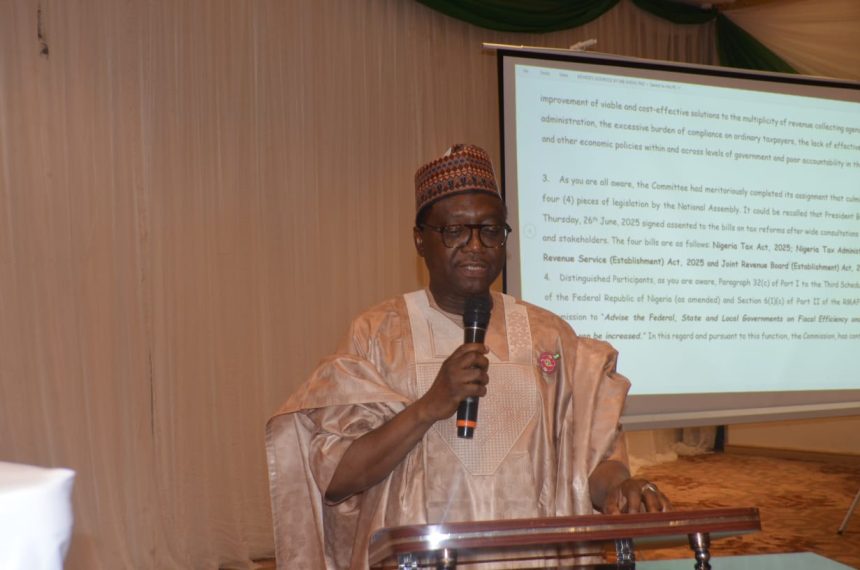
The significant rise in revenue inflows was disclosed by the Chairman of the Revenue Mobilisation and Fiscal Commission (RMAFC), Dr. Mohammed Shehu, at a two-day National Stakeholders’ Discourse on Enhancing Fiscal Efficiency and Revenue Growth under the Nigeria Tax Act, 2025, in Abuja.
Dr. Shehu confirmed the scale of the increase, stating that the total gross accruals into the account were N11,930,865,030,521.50 in 2023 and N21,432,592,362,620.70 in 2024. The revenue continued its upward trajectory, with ten-month accruals from January to October 2025 hitting N23,058,248,707,725.50.
Dr. Shehu linked the improving revenue profile to broader macroeconomic stability, noting that inflation had consecutively dropped over four months, and the Naira exchange rate strengthened from N1,534 to the dollar in July to N1,428 in October.
Moving forward, the RMAFC will intensify monitoring of revenue collections and disbursements through enhanced oversight, forensic audits, and stronger collaboration with subnational governments on non-oil revenue mobilisation.
The RMAFC Chairman attributed the sustained growth to a suite of measures, including fiscal reforms, stronger audits, digital tracking, and enhanced coordination among revenue agencies. He noted that these steps have “strengthened fiscal discipline and expanded the revenue pool for allocation to federal, state and local governments.”
Dr. Shehu stated that this positive shift “marks progress towards a more resilient, diversified and sustainable public finance system with less dependence on oil earnings.”
He pointed out that historically, the Nigerian economy has struggled with structural weaknesses. “The Nigerian economy had suffered from boom-burst cycles driven by volatile oil prices, creating unpredictable revenue streams that undermine long-term planning and fiscal stability,” he said, adding that this problem is compounded by high debt-service obligations that “consume an alarming proportion of government revenue.”
The National Stakeholders’ Discourse was convened to discuss the new Nigeria Tax Act, 2025, which Dr. Shehu described as timely and necessary. He announced that the Act, set to take effect on January 1, 2026, is specifically designed to address these structural challenges.
“The Nigeria Tax Act, 2025, has not only harmonised the hitherto Nigeria’s fragmented tax laws into a single statute, but it has also reduced or eliminated duplication and obsolete provisions while enhancing ease of doing business,” Dr. Shehu affirmed.
He explained that the legislation will create a more coherent and predictable fiscal environment, eliminate regional differences in tax administration, and reduce compliance burdens for taxpayers.
Professor Taiwo Oyedele, Chairman of the Presidential Fiscal Policy and Tax Reforms Committee, provided further insight into the radical nature of the reforms, asserting that “These reforms should have been done 20 or 30 years ago. Things got so bad with our tax system that incremental fixing would no longer solve the problem. We needed a transformation.”
Professor Oyedele lamented the country’s operation of over 60 different taxes and levies, noting that the multiplicity of taxes encourages corruption. He argued for efficiency over number, stating that if “it is only two taxes that are efficiently collected or operated, it is better than 50 of them that are not properly harnessed.”
The reforms, he explained, are designed to correct decades of structural weaknesses and stop what he called “taxing poverty, capital and investments” using outdated statutes.
A key focus of the NTA 2025 is fairness and providing relief to citizens. Professor Oyedele disclosed that under the new tax laws, low-income earners, including those on the national minimum wage, will be exempted from Personal Income Tax from January 2026.
The Act also targets lower living costs by zero-rating essential consumption items such as food, transport, health, education, and rent for Value Added Tax (VAT). Furthermore, most investors will be exempted from Capital Gains Tax to deepen the capital market and support economic growth.
The reforms are structured to raise government revenue without introducing new taxes by closing a “wide tax gap” and removing wasteful incentives.
Stakeholder Support and Economic Context
The commitment to reform received broad support. Desmond Akawor, Chairman of the Fiscal Efficiency and Budget Committee of the RMAFC, explained that the Act represents a major milestone aimed at modernizing tax administration and expanding the revenue base. “The choices we make today will shape the stability, sustainability and resilience of Nigeria’s public finances for many years to come,” he said. He added that active participation and cooperation among all stakeholders “remain indispensable.”
In a goodwill message delivered by his representative, the Governor of the Central Bank of Nigeria, Mr. Olayemi Cardoso, stated that the reforms are aimed at broadening the tax base, improving compliance, reducing dependence on oil revenues, and strengthening transparency through a modernised and digitalised tax administration system.