
Dangote: Refinery Has Ended Nigeria’s 50-Year Struggle With Fuel Queues
By Patience Ikpeme

Nigeria’s decades-long struggle with fuel scarcity and queues at petrol stations has finally been laid to rest, according to the President/Chief Executive of Dangote Petroleum Refinery, Aliko Dangote.
Speaking at a conference in Lagos to mark the first anniversary of the commencement of petrol production at the 650,000 barrels-per-day refinery, Dangote said the project has transformed the downstream petroleum sector and delivered relief to Nigerians.
“We have been battling fuel queues since 1975, but today Nigerians are witnessing a new era,” he declared.
Dangote recalled that since the refinery began producing Premium Motor Spirit (PMS) on September 3, 2024, the fuel supply crisis that had persisted for half a century has been steadily resolved. He admitted that the journey had been fraught with opposition, doubts, and enormous risk.
“The decision to build the refinery was not easy. If it had gone wrong, lenders would have taken our assets. But we believed in Nigeria and Africa,” he said, noting that experts, investors and even government officials had discouraged him, warning that only sovereign nations could undertake such large-scale refinery ventures.
Dangote said that the impact of the refinery is already visible in the reduction of petrol prices. Before production commenced, pump prices had climbed to nearly ₦1,100 per litre. However, he noted that the refinery’s intervention has helped to bring the price down to ₦841 in the Southwest, Abuja, Delta, Rivers, Edo and Kwara.
He added that with the rollout of Compressed Natural Gas (CNG)-powered trucks for nationwide distribution, the price reduction will soon extend to all parts of the country.
Beyond stabilising the local market, Dangote disclosed that the refinery has also contributed to foreign exchange earnings. Between June and the first week of September 2025, the refinery exported over 1.1 billion litres of PMS.
On employment, Dangote said the project is generating rather than displacing jobs. He explained that the deployment of 4,000 CNG-powered trucks will create at least 24,000 direct and indirect jobs across Nigeria.
“We have not displaced any jobs; we are creating many more. The CNG trucks will not be operated by robots,” he said.
According to him, refinery workers and drivers enjoy wages well above the national minimum wage, alongside life insurance, health insurance covering their families, and a lifelong pension. “Our employees earn salaries three times the minimum wage. Our drivers receive a living wage, life insurance, health insurance covering themselves, their spouses, and up to four children, as well as a lifelong pension,” he added.
He stressed that union membership for drivers remains a matter of personal choice and not company policy.
Dangote used the anniversary to restate his call for stronger support for Nigerian industries, warning against the dumping of cheap imports that undermine local production.
“Other nations were not industrialised by outsiders. We must build and industrialise our own economies. Without this, how can others invest? That is why I believe the National Assembly should enact legislation to support the Federal Government’s ‘Nigeria First’ policy,” he said.
According to him, Nigeria’s textile industry is a cautionary example of what happens when local industries are left unprotected. He argued that sustainable growth will only come from prioritising local production and building a circular economy.
“Relying on imports means exporting jobs and importing poverty,” he warned.
Looking ahead, Dangote revealed that the refinery will expand capacity to 700,000 barrels per day in its second year of operation. He also announced plans for Nigeria to become Africa’s refining hub and one of the world’s largest producers of polypropylene and fertiliser.
“Nigeria has now become the refining hub of Africa. We are set to become the largest exporter of polypropylene and are aiming to make Nigeria the world’s leading producer of fertiliser. These initiatives will generate substantial foreign exchange, create employment, and stimulate growth in other sectors,” he said.
He made it clear that the refinery will not venture into the retail market, explaining that the company turned down opportunities to acquire filling stations when they were offered for sale. Instead, the refinery will remain open to partnerships and collaborations with other stakeholders in the downstream sector.
Dangote expressed gratitude to the Federal Government, the refinery’s partners, its workforce, and the Nigerian public for their support. He also commended the Independent Petroleum Marketers Association of Nigeria (IPMAN) for mobilising its members to participate in the CNG-powered truck distribution initiative.
He assured Nigerians that security agencies are fully equipped to protect both the trucks and their operators. “Nigeria is a country governed by the rule of law, and security agencies are empowered to protect its citizens and infrastructure,” he said.
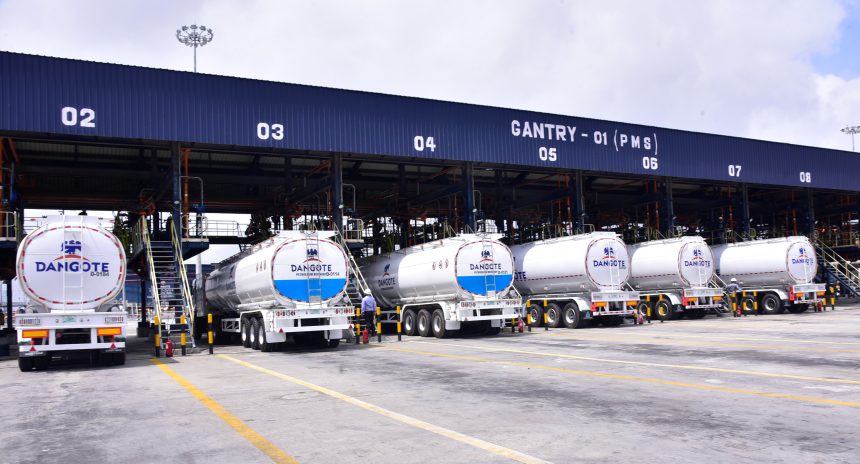
Dangote showcased some of the CNG-powered trucks already loading petrol from the refinery, stating that the full deployment of all 4,000 trucks will soon be achieved.