
RMAFC Begins Review of Anambra’s ₦70bn Stabilization Fund Request
…Committee says Presentation is not Automatic Approval
…Team Prepares to Inspect Projects in the State
By Patience Ikpeme
A committee of the Revenue Mobilisation, Allocation and Fiscal Commission (RMAFC) has received Anambra State’s request for ₦70 billion from the Stabilization Fund. The money would pay for priority projects and other investments in key sectors of the state’s economy.
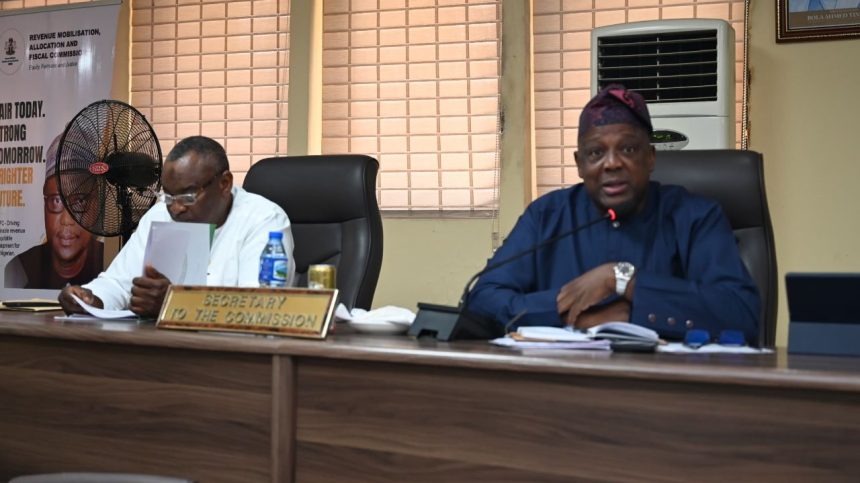
The Indices and Disbursement Committee heard the state’s presentation at a technical session at the Commission’s headquarters in Abuja on Tuesday, 20th October 2026. The request covers security, environmental management, infrastructure, healthcare, education, agriculture, solid minerals and tourism.
The committee chairman, who is also the Commissioner representing Lagos State, Prof. Olusegun Adekunle Wright, praised the Anambra government for bringing its financial challenges before the committee. He explained that the Stabilization Fund is meant to help states in genuine need, but only within set rules.
According to a statement issued on Wednesday by the Head of the Commission’s Information and Public Relations Unit, Hajia Umar Maryam Yusuf, Prof. Wright said the Fund is “an important fiscal intervention mechanism intended to provide assistance in deserving circumstances, subject to established guidelines, availability of resources and the appropriate approval processes.”
He made it clear that the session does not mean the money has been approved. The technical review, he said, “did not constitute automatic approval.” The request remains open to further checks and possible recommendations to the full Commission, known as the plenary.
Prof. Wright said the Commission’s rules require any state seeking money from the Fund to first make a formal presentation. Only after that can officials visit the state to inspect the proposed projects on the ground. The committee will check whether the state’s financial records can be trusted, whether the projects are workable and their costs reasonable, what is needed to carry them out, and what benefits ordinary people in the state will get.
Presenting for Anambra, the Secretary to the State Government, Chiamaka Nnake, described the state’s economy, its income, its spending pressures and its development plans.
She said Anambra has 21 local government areas and 179 communities. It has an estimated 8.9 million people, a gross domestic product of about $12.7 billion and a projected 2026 budget of ₦766 billion.
Ms Nnake said the state has raised its internally generated revenue from about ₦2.2 billion to about ₦7.2 billion. She said its economy is driven by the commercial and industrial centres of Awka, Onitsha and Nnewi, as well as its oil-producing areas.
She named insecurity, erosion, flooding, inflation and the rising cost of public services as the main pressures on the state’s finances. Sit-at-home orders and restrictions on movement, she said, have disrupted business, reduced government income and made investors less confident.
On erosion, she said Anambra has more than 1,000 erosion sites, with 146 communities affected to varying degrees. She estimated that about ₦170 billion would be needed to fix the most serious sites. That is more than twice the ₦70 billion being requested. She listed work already going on, including erosion control, flood management, road repairs, land reclamation, clearing of waterways and tree planting. The state has also restricted sand mining near vulnerable areas. She asked for more resources to protect communities and key infrastructure.
On security, Ms Nnake said the state has passed a Homeland Security Law, set up a state security outfit and works with a joint task force. She said extra funds would buy patrol vehicles, surveillance and communication equipment, and pay for staff training and better coordination. This, she said, would protect lives and property, bring back investor confidence and revive economic activity.
On health, she said the state’s free antenatal care and delivery programme has supported more than 206,000 deliveries, including 642 Caesarean sections, at no cost to the women involved. In education, she said the state has recruited 8,415 teachers and introduced free education from nursery to Senior Secondary School Three.
She said these programmes have raised the demand for doctors and nurses, equipment, medicines, classrooms and learning materials. The state must therefore keep spending to maintain quality and reach more people.
Ms Nnake described agriculture as a major chance for the state to earn from more than one source. She said it has given out more than 2.3 million coconut and oil-palm seedlings. She called for investment in processing, storage, irrigation, cold-chain facilities and market access, so that farmers produce more, lose less after harvest and create jobs.
She also pointed to the state’s minerals, which include kaolin, bentonite, lignite, silica sand, gypsum and laterite, along with oil-related opportunities. To attract investors, she said, the state needs geological surveys, processing plants and supporting infrastructure.
On tourism, she cited Agulu Lake and other natural and heritage sites. Better access roads, visitor facilities and supporting infrastructure, she said, would make the state a more attractive destination and bring jobs, investment and income.
Concluding, she repeated the request for ₦70 billion. The money, she said, would add to what the government is already spending, keep essential services running, protect livelihoods, improve investor confidence and help build a stronger economy that does not depend on one source of income.
In his closing remarks, the Commissioner representing Anambra State, Dr. Enefe Ekene, thanked the committee chairman for presiding. He also thanked fellow commissioners for their patience and sharp observations, and the committee secretariat for its guidance.
He said the observations made at the session would help the Anambra delegation improve its presentation before the planned visit to the state. He said he was hopeful the engagement would produce good results.
The committee said its decision would depend on the financial documents supplied, the feasibility of the projects, their costs, what is needed to carry them out and the expected benefits. It added that any recommendation would still be subject to further checks and the proper procedures.