G24 Chairman Oyedele Says Developing Countries Pay Too Much to Borrow
…Says it is the wrong time for new taxes

…Urges IMF and World Bank to Provide cheaper loans
By Patience Ikpeme
BANGKOK, Thailand – The Chairman of the Intergovernmental Group of 24 (G24) and Nigeria’s Minister of Finance and Coordinating Minister of the Economy, Mr Taiwo Oyedele, has said developing countries, especially those in Africa, are paying far more than they should to borrow money. He called on the International Monetary Fund (IMF) and the World Bank to help bring the cost down.
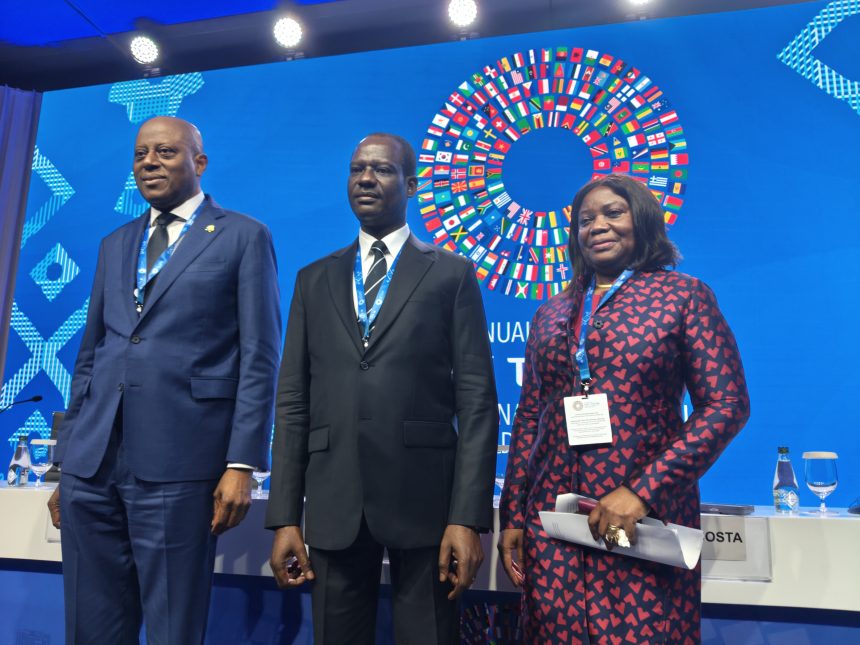
Mr Oyedele spoke as Chairman of the G24 at a press conference on the sidelines of the 2026 IMF/World Bank Annual Meetings in Bangkok. The G24 brings together developing countries to agree on common positions on global economic matters.
He told journalists that member countries reached agreement on their 2026 annual meeting communique after wide consultations. According to him, the document represents a shared view from the global south on how to support growth, stability and prosperity around the world.
Speaking for the group, Mr Oyedele said borrowing is necessary for growth and every country, rich or poor, should be able to use it in ways that create jobs and benefit everyone. The problem, he said, is that many developing nations now carry a heavy load of debt and also pay dearly for it. “What we have seen by members of the G24 and across, particularly the developing countries, such as those in Africa, is the increasing burden of not just high debt, but high costs of debt,” he said.
He said some estimates show these countries pay about $500 billion more than they should when compared with what developed countries pay.
To ease the pressure, the G24 Chairman said governments must first look at their own books to find areas where they can save money and collect more revenue. However, he warned against raising taxes at this time. “This is the wrong time to impose new taxes or increase the burden of tax, particularly on the vulnerable population and productive sectors of the economy,” he said.
He added that the G24 wants the IMF and the World Bank to make cheaper, concessional loans available in the short term to vulnerable countries. Over the longer term, he said, the two institutions should develop plans and policies that bring in private investment, so that limited public money can be spent mainly on services such as health and education.
Mr Oyedele said taxes and debt should be seen as two sides of one coin, since borrowing today means higher taxes tomorrow. “Debt is future taxes,” he said, adding that governments should keep ordinary people at the centre of their decisions. This, he said, will not make policy perfect, but it is more likely to produce a balance that works and can last.
On climate change, the Chairman said any action must be fair to all countries and must reflect the principle that nations carry different responsibilities according to their capacity. He called on the World Bank, regional development banks and other partners to deliver on the promise made at COP29 of at least $300 billion a year in climate finance by 2035.
Responding to a question on whether Africa would get a fair share of climate funds, given how little the continent contributes to global carbon emissions, Mr Oyedele admitted there are no guarantees. He argued, however, that fairness demands support for Africa. “There’s no planet for Africa, planet for America, for Asia, it’s our planet,” he said.
He explained that richer nations have an interest in helping poorer ones grow without raising their pollution levels, and that growth should not be held back in the name of protecting the environment. “You don’t want a clean world with hungry people,” he said.
Answering a question on how to ensure that IMF and World Bank advice leads to better living standards, the G24 Chairman said growth must be felt in people’s lives. “Growth is not just for the sake of growth, it has to be job-rich, it has to be inclusive,” he said. He added that this is a shared duty and does not rest on the two institutions alone.
Mr Oyedele also raised concern about artificial intelligence. He warned that if countries are not deliberate in how they regulate and adopt the technology, it could produce growth alongside rising unemployment. He described this as a major challenge for countries with large youth populations.
On trade, he said this is a time for cooperation, not restrictions. He noted that he was not sure there had ever been a good time to limit exports or place heavy tariffs and other barriers on trade. He also warned that the weather pattern known as El Niño is expected to affect many G24 members and could threaten food supplies, which adds to the need for climate funding.
In the communique, the G24 said global growth is under pressure from wars, changing trade policies, uncertainty over interest rates, unstable commodity prices and more frequent climate shocks. These pressures, it said, weigh heaviest on emerging and developing economies.
The group called for a well-funded IMF built on member quotas, and for changes to quotas so that they reflect each country’s weight in the world economy and protect the voice of developing members. It also asked that IMF programme conditions support growth, protect social spending and avoid harsh early cuts that could damage recovery.
On the World Bank, the G24 welcomed the institution’s 2030 targets and its discussion on industrial policy. It asked for more creative ways of raising funds and more support for local capital markets in developing countries. It also said the Bank’s 2030 review of shareholding should follow the Lima principles and give emerging economies a stronger voice.
The communique further called for debt relief that is timely, orderly and coordinated, with greater openness and fairer credit rating assessments. It also asked for tax cooperation that stops companies from shifting profits to avoid tax and curbs illegal money flows out of poor countries, and welcomed progress under the United Nations tax convention and the OECD/G20 framework.
The group concluded that confidence in the world economy can only return if the global system respects the independence of nations and the principles of the United Nations Charter.