Nigeria, Germany Target Industrial Investment for $1tr Economy
By Patience Ikpeme

Nigeria is seeking to turn its longstanding relationship with Germany into concrete investments, technology transfers and industrial projects as the Federal Government intensifies efforts to expand productive capacity and achieve its ambition of building a $1 trillion economy by 2030.
Minister of Budget and Economic Planning, Senator Abubakar Atiku Bagudu, said yesterday that Nigeria was ready to deepen industrial and economic cooperation with Germany, particularly in sectors capable of increasing production, creating jobs and strengthening the competitiveness of Nigerian businesses.
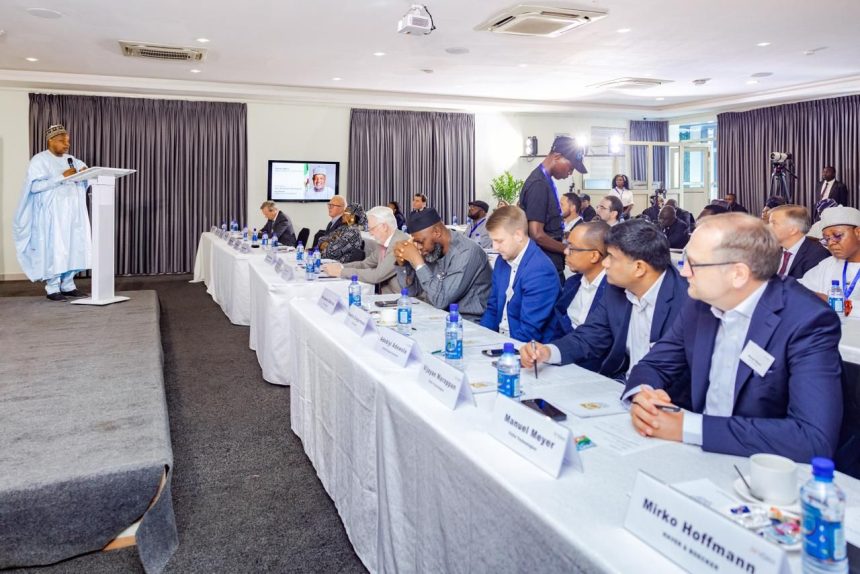
Bagudu spoke in Abuja at the Germany-Nigeria Industrial Technology Conference, tagged “Business Meets Nigeria”, organised by the German Engineering Federation (VDMA) in partnership with the German Embassy in Nigeria.
The minister said the focus of the renewed engagement should be on converting the long relationship between both countries into investments that can expand Nigeria’s industrial base and create greater value within the domestic economy.
He said the government’s objective was to create conditions in which private businesses could invest more, increase production, employ more Nigerians and generate greater economic value.
According to him, the Federal Government’s ongoing economic reforms are aimed at addressing structural problems in the economy while creating a more favourable environment for private investment.
Bagudu said the target of a $1 trillion economy by 2030 could not be achieved by government spending alone, stressing that the private sector would have to play a central role in expanding production and investment.
He pointed to manufacturing, mining, construction and infrastructure as areas where Nigeria needed increased investment and domestic value addition, creating opportunities for German companies with expertise in industrial equipment and technology.
“The ambition to build a $1 trillion economy requires strong private-sector participation, greater domestic value addition and increased investment in productive sectors,” Bagudu said.
The minister said German companies could play an important role by providing machinery, industrial equipment, technology and infrastructure solutions needed to increase production across several sectors of the Nigerian economy.
A major issue raised at the conference was how to finance projects capable of attracting foreign investors and delivering measurable economic benefits.
Bagudu said Nigeria needed more investment-ready projects that could meet the requirements of lenders and development finance institutions.
He identified export credit, development finance, commercial bank lending and guarantees as some of the financing channels that could help turn business opportunities into actual investments.
The minister cited a €300 million German export credit guarantee framework as one of the instruments that could support the growing economic relationship between Nigeria and Germany.
The financing arrangement could become particularly relevant for Nigerian companies seeking German machinery and technology, as well as German firms looking to participate in projects in Nigeria, provided the proposed investments meet the relevant financing and project requirements.
The emphasis on financing reflects one of the major challenges facing industrial development in Nigeria: moving from identified investment opportunities to projects that are sufficiently prepared and financed to begin implementation.
The conference therefore brought together government officials, German engineering and technology companies, Nigerian businesses, financial institutions and other industry players to discuss possible investments, technology transfer, infrastructure development and industrial cooperation.
The meeting was also part of a high-level visit by 14 German companies operating in the cement, mining, construction and industrial technology sectors.
The companies held engagements with Nigerian businesses and other stakeholders in Lagos and Abuja as they examined areas where partnerships could be developed for investment and industrial expansion.
Head of the VDMA delegation, Dr Chux Onaa, said German machinery and equipment manufacturers had technologies that could assist Nigeria in improving industrial productivity.
He identified materials handling, cement and minerals processing, digital technology and environmental solutions among the areas where German companies could contribute to Nigeria’s industrial development.
Onaa said the objective was not simply to sell equipment to Nigerian businesses but to develop longer-term partnerships involving investment, technology transfer and industrial cooperation.
The German companies’ interest is significant because much of Nigeria’s industrial development depends on access to modern machinery, reliable production systems and technologies that can improve efficiency and reduce production losses.
For Nigerian manufacturers and other industrial operators, access to appropriate equipment and technical expertise can also affect their ability to compete with imported products and participate more effectively in regional and global markets.
Deputy Head of Mission at the German Embassy in Nigeria, Ambassador Johannes Lehne, said the bilateral relationship between both countries remained strong, adding that Nigeria’s economic reforms had contributed to improved trade and the business environment.
He said German and Nigerian businesses now had access to different financial instruments that could support private-sector projects.
Lehne said the financing tools could provide competitive funding for viable projects and enable companies from both countries to work together in developing the Nigerian market.
The German position points to a shift from government-to-government economic relations towards stronger private-sector participation, with financing expected to serve as a bridge between investment opportunities and actual projects.
For Nigeria, the larger objective is to attract capital that will increase domestic production rather than simply finance the importation of finished goods.
This makes sectors such as mining, cement, manufacturing, construction and industrial processing particularly important because investments in these areas can create demand for local suppliers, generate employment and increase domestic value addition.
The presence of German companies with expertise in industrial machinery and processing also creates an opportunity for Nigeria to negotiate partnerships that go beyond equipment purchases to include local skills development, maintenance capacity and technology transfer.