
RMAFC Finalises New Revenue Formula and Political Salary Reforms
By Patience Ikpeme
The Revenue Mobilisation Allocation and Fiscal Commission (RMAFC) has concluded what it called a comprehensive review of Nigeria’s Revenue Allocation Formula and finalised work on the review of remuneration for political, public, and judicial office holders.
Both key fiscal processes have reached advanced stages of consideration by relevant authorities, positioning the federal government for sweeping structural adjustments in national revenue sharing and public sector pay.
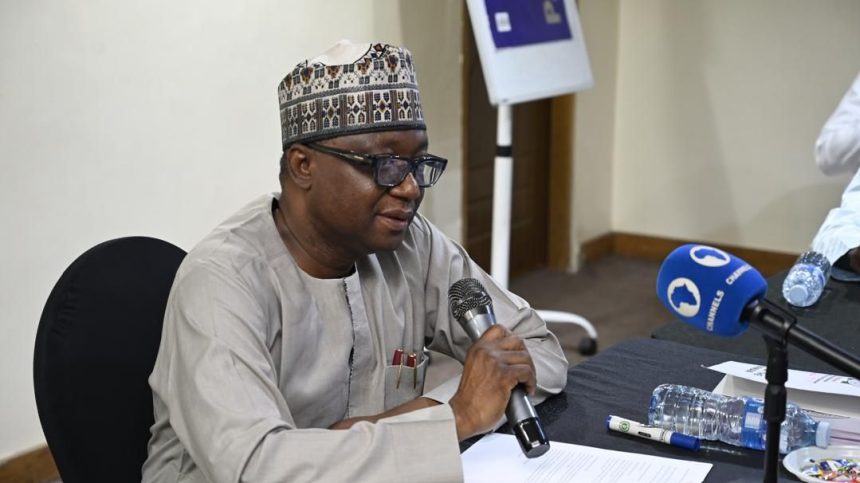
The Chairman of the Commission, Dr. Mohammed Bello Shehu, disclosed these developments during an interactive session with members of the Nigerian Guild of Editors in Lagos.
Presenting an overview of the agency’s achievements from 2023 to date, the Chairman noted that the institutional focus has revolved around strengthening statutory mandates, including revenue monitoring, derivation verification, fiscal coordination, and administrative oversight.
Giving further details on the progress of public service pay structures, Dr. Shehu stated that the review of remuneration for judicial office holders had already materialized with the passage of the Judicial Office Holders (Salaries and Allowances) Act, 2025.
Building on that legislative milestone, the Commission has advanced plans to adjust the earnings of the remaining arms of government.
“The review of remuneration for executive and legislative office holders is also at an advanced stage, with an executive bill on the Political and Public Office Holders (Salaries and Allowances) Act, 2026 expected to be transmitted to the National Assembly,” Dr. Shehu said.
He stressed that financial compensation must correspond with higher standards of public leadership and operational outcome..”Remuneration reforms must be matched with accountability and performance. Improved pay should translate into improved service delivery,” the RMAFC chief stated.
Addressing the long-standing question of how national funds are distributed across the federation, Dr. Shehu explained that updating the Revenue Allocation Formula represented one of the most critical responsibilities handled by the agency. He noted that the process required extensive consultations across every level of government, key technical stakeholders, and civil society representatives nationwide.
According to the Chairman, the comprehensive review evaluated institutional responsibilities, historical revenue streams, and global federal models to produce a cohesive framework.
“The exercise involved analysis of fiscal responsibilities, revenue trends, and comparative federal systems, resulting in a harmonised report and legislative proposals now ready for transmission to the appropriate authorities,” Dr. Shehu said, adding that the principal goal is “to establish a more equitable and sustainable revenue-sharing framework that reflects current economic and governance realities.”
To support these broader constitutional objectives, the Commission focused heavily on verifying production outputs and safeguarding resource allocations. Dr. Shehu explained that the agency intensified its direct monitoring of oil and gas production metrics to maintain the integrity of the 13 percent derivation principle.
Through field verification, advanced geospatial mapping, and technical inter-agency collaboration, the agency settled long-running disputes regarding resource locations, including the formal reassignment of 17 oil wells from Imo State to Rivers State following a ruling by the Supreme Court.
Similar field interventions were executed across Cross River, Akwa Ibom, Imo, and Anambra States. Furthermore, enhanced reporting standards in natural gas production enabled Enugu and Kogi States to join the list of derivation revenue beneficiaries.
To consolidate its oversight, the agency expanded structural ties with key regulatory and statistical institutions, including the Nigerian Upstream Petroleum Regulatory Commission, the Nigerian National Petroleum Company Limited, the Nigerian Midstream and Downstream Petroleum Regulatory Authority, the National Boundary Commission, and the Office of the Surveyor-General of the Federation.
The Chairman also disclosed active joint engagements with the Ministry of Defence to combat crude oil theft, pipeline vandalism, and production leaks, which he categorized as primary threats to federal receipts. Beyond traditional extraction sectors, the Commission is pursuing non-oil targets by forming technical partnerships with the Federal Airports Authority of Nigeria and the National Space Research and Development Agency, utilising satellite and geospatial technologies to locate uncaptured revenue streams.
Dr. Shehu reported parallel improvements in internal operations, including facility upgrades, physical security enhancements, and administrative updates at the agency’s headquarters. Staff welfare programs were expanded through healthcare provisions and targeted technical training to build internal analytical capacity.
The operational briefing was arranged to deepen public transparency and foster clearer coverage of state fiscal governance. “This engagement is part of efforts to deepen transparency, data-driven reforms, and proactive communication in public finance through a stronger partnership with the media,” Dr. Shehu said.
Concluding the session, the Chairman of the Public Affairs and Communication Committee and Federal Commissioner representing Kwara State, Honourable Ismail Muhammed Agaka, commended journalists for safeguarding democratic accountability and expressed the agency’s intention to maintain continuous dialogue with national stakeholders.