

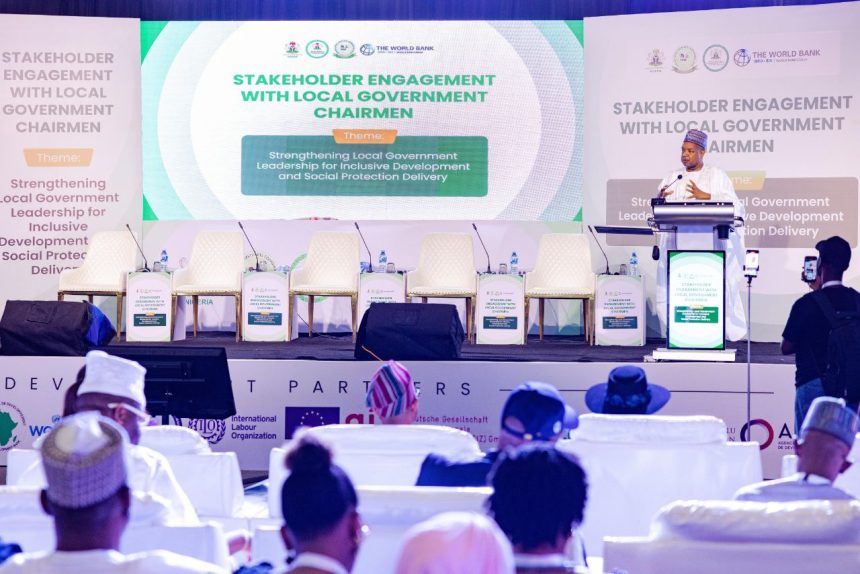
FG Urges LGs to Deepen Social Protection
By Patience Ikpeme

The Federal Government has called on local governments across the country to take a stronger role in promoting inclusive development and improving social protection for Nigerians at the grassroots level.
The call was made by the Minister of Budget and Economic Planning, Senator Abubakar Bagudu, during a stakeholder engagement with Local Government Chairmen organised by the National Social Safety Nets Coordinating Office (NASSCO) in Abuja.
Speaking on the theme, “Strengthening Local Government Leadership for Inclusive Development and Social Protection Delivery,” Bagudu said all levels of government must work together to improve the welfare of citizens and reduce hardship in communities.
He said the Nigerian Constitution places both legal and moral responsibilities on public office holders to protect the welfare of the people and ensure that development reaches every segment of society.
“At the heart of governance in Nigeria is the achievement of the Fundamental Objectives and Directive Principles of State Policy as set out in the Constitution of the Federal Republic of Nigeria,” the minister said.
Bagudu noted that despite the efforts of many Nigerians to earn a decent living, several citizens still struggle because of economic difficulties, insecurity and weak market conditions.
“We must recognise that many hardworking Nigerians — farmers, fishermen, herders, traders, and small business owners — often do not receive returns commensurate with their effort. This makes social protection and inclusive governance necessary,” he stated.
According to him, tackling poverty and social challenges requires cooperation among the federal, state and local governments, as well as support from development partners, civil society groups and community leaders.
The minister said Section 13 of the Constitution makes it compulsory for all authorities exercising government powers to work together in pursuing national development goals.
He explained that this responsibility applies to the President, governors and local government chairmen, adding that collaboration among the different levels of government is necessary for inclusive growth and improved living conditions.
Bagudu also spoke about the 2017 National Social Protection Policy, which created major intervention programmes and structures aimed at supporting vulnerable Nigerians.
He listed some of the programmes to include the National Social Safety Nets Coordinating Office, N-Power and the National Home-Grown School Feeding Programme.
The minister said President Bola Tinubu’s administration remains committed to grassroots-focused development under the Renewed Hope Agenda.
He disclosed that the National Economic Council had approved the Renewed Hope Ward Development Programme to help identify economic opportunities and development needs in wards across the country.
According to him, the initiative is expected to improve planning and coordination at the grassroots by helping communities and local governments identify service gaps, ongoing programmes and priority areas for intervention.
“The programme aims to ensure that all interventions within a ward communicate and coordinate effectively,” he said.
Bagudu expressed concern that many development projects and intervention programmes currently operate independently without proper coordination among states and local governments, resulting in duplication of efforts and waste of resources.
He said improved collaboration among government agencies, humanitarian organisations, development partners and community stakeholders would help deliver better results for Nigerians.
The minister urged local government chairmen to take full responsibility for development activities within their councils, describing them as the closest level of government to the people.
“Local government chairmen, as the chief executives of their councils, must take ownership of development outcomes within their jurisdictions,” he said.
Bagudu also advised local government leaders to focus not only on demands for higher allocations but also on identifying economic opportunities that already exist within their communities.
According to him, many local governments possess vast untapped resources and economic potential that could support prosperity and inclusive development if properly managed in partnership with state and federal authorities.
He added that the Federal Government would continue to strengthen social protection systems to ensure that ongoing economic reforms produce real benefits for ordinary Nigerians.