

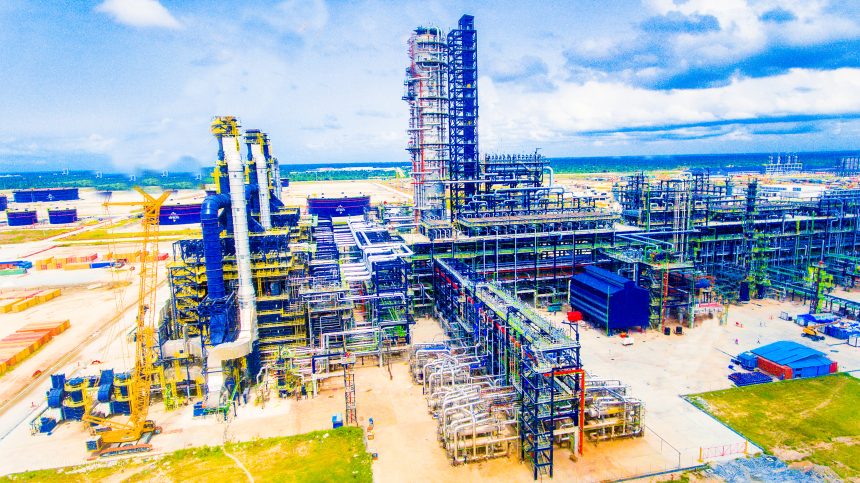
Dangote Refinery Shifts Nigeria to Net Petroleum Exporter
By Patience Ikpeme

Nigeria has officially transitioned from a perennial importer of fuel to a net exporter of gasoline also known as petroleum.
Data covering the month of March 2026 reveals that the Dangote Petroleum Refinery & Petrochemicals exported an average of 44,000 barrels per day (b/d) of gasoline, marking a historic pivot for Africa’s largest economy.
For the first time in the nation’s history, Nigeria recorded a gasoline surplus of approximately 3,000 b/d during the period. This shift represents a seismic change for a country that, for decades, saw its foreign exchange reserves drained by heavy reliance on refined petroleum products from Europe and the Middle East.
The surge in output from the massive 650,000 b/d capacity complex in Ibeju-Lekki has not only satisfied domestic demand but has also begun to reshape international supply routes. Market intelligence from the firm Kpler indicates that as Dangote’s production climbed, Nigeria’s gasoline imports plummeted to a record low of 41,000 b/d in March. During the same window, crude oil supply to the facility rose to 565,000 b/d, representing the second-highest processing rate since the refinery commenced operations in late 2023.
The facility is now looking well beyond West African borders to find buyers for its growing surplus. In a strategic expansion of its international footprint, the refinery successfully delivered its first cargo to East Africa, sending 317,000 barrels of gasoline to Mozambique. This move comes as buyers in the East African region seek to diversify their supply chains away from traditional Middle Eastern sources, which have faced persistent logistics disruptions. A second cargo is already scheduled for delivery to the Mozambican port of Beira later this month.
Reflecting on the environment that enabled this scale of industrial success, the President and Chief Executive of Dangote Industries Limited, Aliko Dangote, noted that the current administration’s policy direction played a central role.
“The economic and energy sector reforms of President Bola Ahmed Tinubu have been instrumental in restoring investor confidence,” Dangote stated. “These reforms created the necessary policy environment for large-scale investments in domestic refining to flourish.”
Economists suggest that the implications of this milestone extend far beyond the energy sector. By eliminating the need for massive gasoline imports, Nigeria is expected to see a significant reduction in the pressure on its foreign exchange market. The resulting inflow of hard currency from exports is projected to support broader macroeconomic stability and provide the Central Bank with more breathing room.
On the global stage, Nigeria’s emergence as a supplier is creating ripples in traditional refining hubs. Analysts point out that the European gasoline market, which is already grappling with oversupply, now faces intense competition from a modern Nigerian complex that enjoys a geographical advantage for Atlantic and African trade.
“Nigeria’s transition is poised to reshape regional trade flows and intensify competition in global fuel markets,” one energy analyst noted, adding that the shift represents a permanent change in how fuel moves across the continent.
With rising processing rates and a growing list of international off-takers, the refinery is cementing Nigeria’s new status as a competitive powerhouse in the downstream sector. The March figures suggest that the era of “fuel poverty” and import dependency has given way to a new chapter defined by energy security and a more influential role in the global petroleum trade.