

Customs Collects ₦7.28tr in 2025
…Government Moves to Speed Up Goods Clearance
By Patience Ikpeme
The Nigeria Customs Service has announced that it collected ₦7.28 trillion in revenue in the 2025 financial year, going beyond the federal government’s target and recording strong growth compared to the previous year.
The Comptroller General of Customs, Mr Wale Adeniyi, said the Service was given a target of ₦6.584 trillion but ended the year with ₦7.281 trillion, which is about ₦697 billion more than expected. He explained that this means Customs grew its revenue by more than 10 percent above the target.
“When we compare this with what we collected in 2024, which was about ₦6.1 trillion, it shows an increase of around ₦1.18 trillion, or about 19 percent in one year,” Adeniyi said.
The announcement came in Abuja during the 2026 World Customs Day celebration, where the federal government also launched a new plan to make it easier and faster for goods to be cleared at Nigeria’s ports and borders.
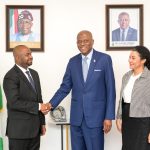
At the event, the Minister of State for Finance, Dr Doris Uzoka-Anite, said the government has given Customs the go-ahead to find and remove the problems that slow down the movement of goods across the country’s trade system.
She spoke during the launch of the Customs Time Release Study, a programme designed to measure how long it takes for goods to move from the point of arrival to final delivery.
“The study will help us track how many hours or days it takes for goods to move across our borders, from clearance to delivery,” she said.
According to her, by carefully measuring these timelines, the government can make better rules and take smarter decisions that will improve trade and business in Nigeria.
“By doing this, Nigeria is taking a clear step towards smarter regulation and better decision-making. The successful use of this study supports the federal government’s ease of doing business plan, strengthens our competitiveness, and helps build an economy driven by trade, growth and development,” Uzoka-Anite said.
She added that Customs plays an important role beyond collecting revenue, especially in protecting the country and the public.
“Beyond trade, the Nigeria Customs Service is central to national security and the protection of society. The Service must continue to improve risk management, use of technology, cooperation with other agencies and proper controls after this study,” she said.
The Minister, who is also Chairman of the Nigeria Customs Service Board, assured stakeholders that the board will continue to support reforms that improve transparency, build stronger institutions and modernise border management.
The Secretary General of the World Customs Organization, Mr Ian Saunders, also sent a goodwill message, calling on Customs services around the world to use the celebration to help people understand the important role they play in protecting lives and society.
“I encourage members to take part in WCO-led operations and make full use of our standards, guidance and tools that are designed to meet the needs of Customs administrations,” he said. “The strength of our vigilance comes from using all the tools we have.”
Giving more details on Customs’ performance in 2025, Adeniyi said the improved revenue was not achieved by putting pressure on honest traders.
“We are not presenting these figures to praise ourselves, but to show that our reforms are producing real results,” he said. “The gains did not come from harsh enforcement or burdening legitimate traders. They came from better compliance, improved use of data, digital tools and disciplined enforcement.”
He said Customs also strengthened its partnership with the private sector while keeping its promise to make trade easier.
On enforcement, Adeniyi revealed that the Service made more than 2,500 seizures in 2025, with the seized goods valued at over ₦59 billion. He said the items included drugs, fake medicines, wildlife products, arms and ammunition, petroleum products, vehicles and substandard consumer goods.
“These seizures prevented serious harm, such as drug abuse, unsafe medical treatment, violent crime, environmental damage and abuse of fuel subsidies,” he said. “But we must remember that vigilance and trade support must go together. A modern Customs Service should be able to find high-risk goods without blocking lawful trade.”
He described the Time Release Study as a major step towards making Nigeria’s ports and borders more secure, efficient and competitive globally.
“The study helps us move from making decisions based on opinions to making decisions based on evidence, and from reacting to complaints to using real data,” he said.
Adeniyi explained that the study, which was carried out at the Tin Can Island Port in Lagos, gave Customs a clear picture of how the clearance process is working.
“It shows that our examination times are fairly efficient and that we have the ability to clear goods quickly,” he said. “But it also shows that long waiting periods caused by manual paperwork, poor coordination and broken scheduling are slowing things down.”
He concluded by saying the main problem is not that Nigeria cannot move goods fast, but that the system often does not allow goods to move fast, and that the new study will help change that.