
2026 Budget to Focus on Wards, Infrastructure and Security
By Patience Ikpeme
The Federal Government has announced that the 2026 budget will concentrate heavily on ward-based development, critical infrastructure, security enhancements, and boosting domestic production as the country navigates a landscape of declining global development assistance.
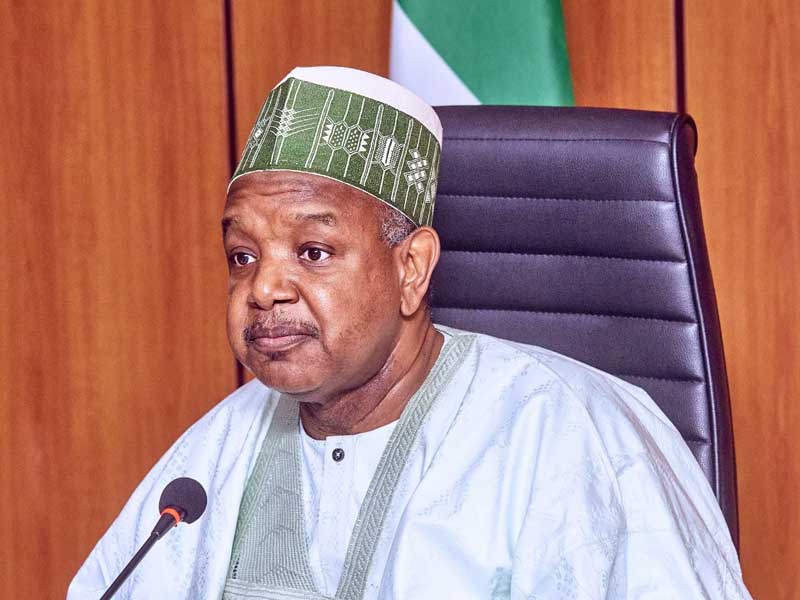
Speaking at a stakeholders’ engagement with the Nigeria International Non-Governmental Organisation (INGO) Forum on Monday in Abuja, Senator Abubakar Atiku Bagudu, the Minister of Budget and Economic Planning, stated that the upcoming fiscal cycle is structured to propel the country toward its ambitious $1 trillion economy target.
Minister Bagudu detailed the strategic shift, explaining that the Medium Term Expenditure Framework (MTEF), which was approved by the Federal Executive Council (FEC), provides the revenue projections, production targets, and a new community-level strategy to drive national growth.
The core of the domestic plan, according to the Minister, is to ensure economic prosperity is felt at the grassroots. “Mr. President and the state governors have met and approved the Renewed Hope Ward Development Plan, where in each of the 8,809 wards, the programs will be designed ward-specific to ensure that economic prosperity in those wards is enhanced,” Bagudu said.
In tandem with grassroots focus, the Minister confirmed a continuous investment in physical assets: “Secondly, the Renewed Hope Infrastructure Fund. The state governors have agreed with Mr. President that there is an irreducible minimum of infrastructure investment that we need to continue making in order to sustain the trajectory of macroeconomic reforms that we are achieving.”
A significant portion of the 2026 fiscal plan will be directed towards security. Bagudu disclosed plans for a joint effort across all three tiers of government.
“Equally, more investment in security by all the three tiers of government,” he noted.
He added that a presidential committee led by the Enugu State Governor is assessing the nation’s security training institutions, stating: “They have presented an initial report where they indicated that an initial sum of $100 billion will be required to boost some of those training institutions. And recall that Mr. President had even directed recruitment of more security agencies, as well as the recall of security agents that are serving in non-operational areas.”
The government is also taking stringent measures to protect national income. “Equally, Mr. President and the National Economic Council have approved a program to ensure that loss of revenue is minimised from crude oil and gas sector, as well as the critical mineral sector,” the Minister explained. “There are allegations that a lot of our precious stones, a lot of our gold are being mined illegally. So all steps have been taken.”
Furthermore, the President has agreed with state governors on a commitment to “embark on more measures to support domestic production.”
Collaboration with INGOs Crucial as Aid Dries Up
The Minister explained that the meeting with INGOs was part of a broader effort to improve coordination, build capacity at the local level, and ensure alignment with Nigeria’s 2026-2030 growth plans.
“We are here to show appreciation on behalf of our nation to all the International Non-governmental Organisations that are engaged in one way or the other with our country’s progress, to hear from them what we can do differently, what we can do better, and how we can learn more from them, particularly given our federal structure,” Bagudu stated.
He acknowledged the role of INGOs in shaping public perception of government changes and offering valuable global insights. “They are instrumental in the way that we can do better as a country, because they have experienced how some countries, where they either come from or they have been engaged with, have solved the problems that we are dealing with currently,” he said.
Bagudu credited the INGO community, saying, “We have embarked on bold, tough reforms under the able and courageous leadership of President Bola Ahmed Tinubu. We couldn’t have done those reforms without their support, because we need public acceptance.”
Representing the international aid community, the Director of the Nigeria INGO Forum, Camilla Higgins, confirmed that the meeting comes at a critical time marked by a dramatic contraction of global development assistance.
Higgins disclosed that Nigeria is among the countries selected for a faster transition out of the international aid system, even as humanitarian needs across the country are mounting.
She noted the severity of the funding gap: “The 2025 humanitarian national response plan sought $910 million but only 24 percent has been fundraised,” making it imperative for the government to raise more local resources to assist people in need.
“What we are experiencing in Nigeria is an example of what’s being experienced globally, that international overseas development assistance is shrinking dramatically,” Higgins said.
She explained that the humanitarian response structure that has existed for nearly 15 years is being dismantled “in order to hand over responsibility more to national actors.”
Higgins cautioned that this transition does not reflect a reduction in need. “As resources are shrinking, the needs across the country are, in fact, growing,” she said. “So we need to partner very strongly with the government of Nigeria to put in place alternative systems and structures that can continue to meet the needs of people across the country.”
She concluded that the priority is now to build stronger systems with the government and redirect national resources to support the delivery of assistance.