

Dangote’s Free Fuel Distribution Initiative Hailed as a Game Changer for Nigeria’s Energy Sector
By Patience Ikpeme
The recent decision by Dangote Petroleum Refinery to absorb the cost of distributing petroleum products nationwide has been described by energy experts as the most transformative development in Nigeria’s oil and gas industry since Independence.
Industry analysts, economists, and stakeholders say the move is poised to ease inflationary pressures, cut production costs, and unlock new growth across critical sectors of the economy—particularly among small businesses and rural communities that have long grappled with high fuel prices.
Bismarck Rewane, Chief Executive of Financial Derivatives Company, noted that the free distribution initiative will address long-standing inefficiencies in the downstream sector while delivering a uniform price of petroleum products across the country. According to him, “What Dangote is doing achieves two key objectives: delivering products across the entire country at a uniform price by eliminating bridging costs and significantly reducing logistics expenses through the use of CNG-powered trucks to reach every corner of the nation.”
He further explained that middlemen—who often play a significant role in pushing up distribution costs—will see their influence reduced. “In economic terms, middlemen—who typically do not invest—are often viewed as parasitic, extracting margins simply for distributing goods. Dangote is bypassing this layer by directly handling distribution and, notably, providing credit facilities to the retail end of the business,” Rewane added.
Rejecting concerns about the refinery emerging as a monopoly, Rewane argued that inefficiencies in Nigeria’s fuel distribution network have been systemic and deeply rooted, and what the Dangote initiative offers is a corrective intervention rather than market dominance.
Kelvin Emmanuel, an energy expert and co-founder of Dairy Hills, said Dangote’s commitment to absorb logistics costs marks a pivotal turning point, ensuring that Nigerians finally begin to experience the real benefits of local refining. “This move means the refinery is taking responsibility for getting products directly to the retail market, and that removes a substantial cost burden that typically lands on the final consumer,” he noted.
Energy analyst Ibukun Phillips described the approach as “revolutionary,” saying it will reshape the energy landscape by improving affordability and accessibility, particularly for rural and low-income consumers. “Rural consumers, who typically pay more despite earning less, stand to benefit immensely. This could also revive abandoned filling stations and promote equitable distribution,” she explained.
The Independent Petroleum Marketers Association of Nigeria (IPMAN) also praised the initiative. According to IPMAN’s National Publicity Secretary, Chinedu Ukadike, independent marketers have long struggled under the weight of high logistics costs due to Nigeria’s non-functional pipeline network. “Our pipelines have been non-functional for years, yet nothing has been done to revive the infrastructure linking the country’s 21 depots. We’ve had to rely on expensive transport from coastal depots,” Ukadike said. “Dangote’s intervention lifts a huge burden off the shoulders of independent marketers.”
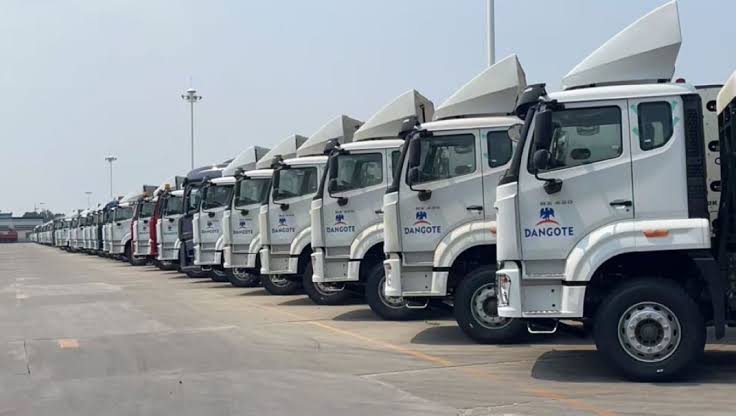
At the heart of this initiative is an investment exceeding N720 billion by Dangote Petroleum Refinery to deploy 4,000 Compressed Natural Gas (CNG)-powered trucks. This nationwide fleet is expected to save Nigeria more than N1.7 trillion annually by removing the average logistics cost of N45 per litre from the retail price.
From 15 August, Dangote Petroleum Refinery will begin direct delivery of petrol, diesel, and aviation fuel to filling stations, industrial users, and other large consumers. The refinery’s plan aims to supply Nigeria’s daily demand of 65 million litres of refined petroleum products, which includes 45 million litres of Premium Motor Spirit (PMS), 15 million litres of diesel, and 5 million litres of aviation fuel.
The financial impact of absorbing logistics costs is significant: the refinery expects to spend over N1.07 trillion each year on free distribution. This cost, previously passed on to marketers and eventually to consumers, is now being removed from pump prices—an intervention stakeholders believe will bring direct relief to households and businesses alike.
Beyond lower pump prices, the initiative is projected to produce wider economic benefits. Over 42 million Micro, Small, and Medium Enterprises (MSMEs) are expected to experience a reduction in energy-related costs, boosting profitability and competitiveness. The programme also promises to generate over 15,000 direct jobs across the logistics value chain, covering truck drivers, station managers, and attendants at new CNG stations.
Dangote Group’s strategy extends beyond cost savings. By investing in CNG infrastructure—including mother and daughter stations nationwide—the company aims to reduce carbon emissions associated with fuel distribution, thereby aligning its logistics approach with global sustainability targets.
Additionally, the direct delivery model is anticipated to help reduce smuggling of petroleum products across Nigeria’s borders, a persistent problem that has drained government revenue and disrupted local supply chains.
The company believes this initiative is part of a broader mission to address structural challenges in Nigeria’s downstream sector, foster economic growth, and advance energy security. “Lower distribution costs mean lower production costs, which in turn help to ease inflationary pressures,” a statement from Dangote Petroleum Refinery noted.
Ultimately, experts see the Dangote free distribution plan as more than just a business move; they view it as an effort that could redefine Nigeria’s fuel supply chain, empower businesses, bring jobs closer to communities, and ensure that the benefits of local refining are truly felt nationwide.