
FG to Review US Tariff Impact on Economy
… MoFI Pushes for Corporate Governance Among SOEs
By Patience Ikpeme
In response to the recent tariffs imposed by the United States on Nigerian exports, the federal government has initiated a review of its economic strategies. Members of the economic management team are reportedly analyzing various scenarios that could unfold if the current tariff situation persists.
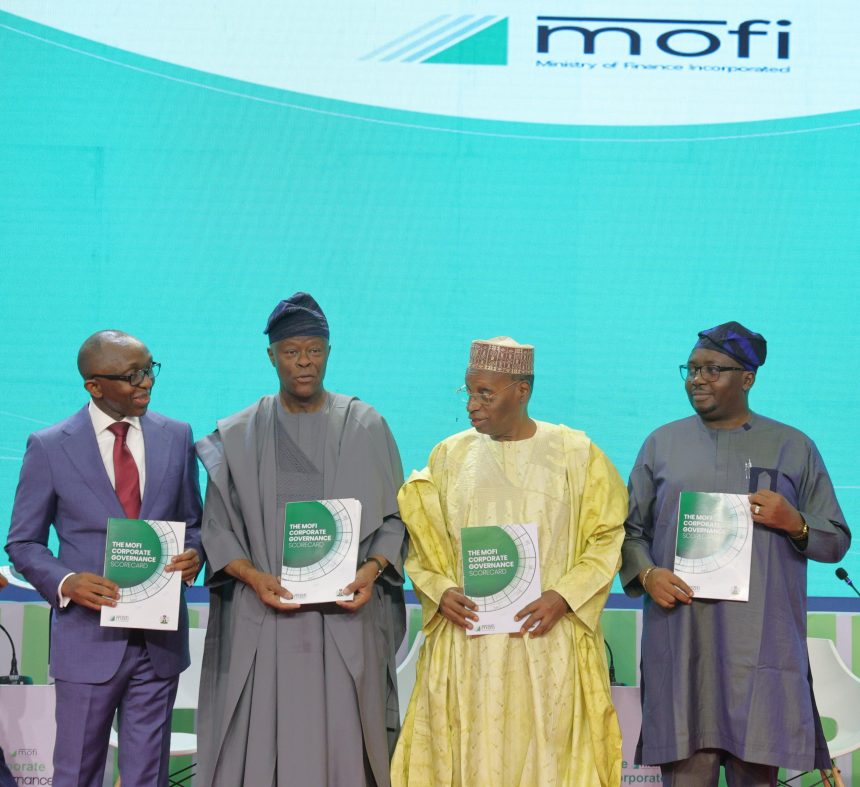
Minister of Finance and Coordinating Minister of the Economy, Mr. Wale Edun, disclosed this information in Abuja on Monday during the launch of a corporate governance scorecard. He stated that the team would advise the government on the appropriate next steps after a thorough examination of the potential outcomes of the US tariff policy.
According to the Minister, “On the one hand, we are going back to the drawing board to look at our budget all over again, because we have to see what changes have been made in the assumption that underlay the production of that budget and the reality over the first quarter and even projected into the future.”
Looking ahead, the Minister observed, “In terms of exports, it’s not too bad because oil minerals are excluded by America from being in any way sanctioned with tariffs. But based on our non-oil exports and based on the formula that the Americans are using, we do have a 14% tariff on our exports.”
He further noted a comparative advantage, stating, “But it’s a lot better than Vietnam, which has 46%. So we need to look at these situations and see what the opportunities are. The Nigeria of today, with a relatively stable economy and an attractive investment environment, including attractive exchange rate, is a place where if they can’t produce in Vietnam, they can come and produce in Nigeria.”
Mr. Edun was however optimistic, saying, “We are here, we are ready, we are waiting, and we have what will be attractive to them in terms of policies, in terms of market, and in terms of export capacity. So that’s the way we are looking at what is going on globally.”
The Minister also pointed out that Nigeria had already imposed a 27% tariff on US exports to Nigeria before the recent US tariff was enacted.
Wale Edun discussed the upcoming Initial Public Offering (IPO) of the Nigerian National Petroleum Corporation (NNPC), stating, “The likes of NNPC, who we have heard, and we have got indication that they are looking to IPO. NNPC is the crown jewel of the Nigerian corporate sector and economy. It is a limited liability company, and if you want to go public, corporate governance is at the heart of what you must achieve.”
He introduced a corporate governance scorecard for state-owned enterprises, describing it as a competitive examination of their management, policies, and operational procedures, with the objective of promoting excellence.
Mr. Edun also spoke about a strategic shift, saying, “But more important than that, rather than relying on budget economy, the whole aim of Mr. President’s strategy of stabilizing the economy and investment environment, of rebounding the private sector…is the focus.” He cited the Highway Development and Management Initiative as an example of engaging the private sector in infrastructure development.
He asserted that the Nigerian economy has stabilized over the past 18 months, noting indicators such as a growing GDP, stabilizing inflation, and decreasing food and fuel prices. He attributed this to a combination of determined monetary and fiscal policies.
Mr. Edun also revealed a move towards leveraging equity and increasing revenue from state-owned enterprises through automation for efficient collection of government dues.
Managing Director of the Ministry of Finance Incorporated (MOFI), Mr. Armstrong Takang, provided a detailed overview of the challenges and opportunities within state-owned enterprises. He revealed concerning statistics, noting that “only 20 out of 52 portfolio companies have audited accounts for the last three years.”
Mr. Takang stressed the critical role of these enterprises in resource mobilization, citing the Bank of Industry’s successful raising of 1.879 billion euros in the international market as a significant achievement facilitated by MOFI’s oversight.
Mr. Takang stated, “Oftentimes, leaders would like to suggest that if I don’t do anything, I cannot be accused of doing it wrong. Many times, not doing the right thing and doing it on time has very severe implications for the growth of our economy. Getting it right puts us on the path to achieving Mr. President’s objectives of getting Nigeria to a $1 trillion economy in short order.” He underscored MOFI’s commitment to improving the performance and transparency of these entities.
World Bank Country Director, Ndiyame Diop, acknowledged Nigeria’s significant portfolio of strategic assets and their potential to boost economic growth and contribute to government revenue. She noted positive contributions from the Ministry of Finance’s policy of automatically splitting revenue collected by federal government entities. She also pointed out the need for continued improvements in transparency and corporate governance within state-owned enterprises, a key focus of MOFI’s current initiatives.
Minister of Power, Adebayo Adelabu, addressed challenges in the power sector due to inadequate adherence to good corporate governance practices, citing poor performance and value erosion in government-owned power entities. He called for improved governance, aligning with MOFI’s objectives, to enhance operational efficiency, boost investor confidence, and ensure regulatory compliance.
Mr. Adelabu insisted that improved corporate governance, a central tenet of MOFI’s mandate, is not only about internal efficiency but also crucial for national development, ensuring efficient use of public resources and supporting energy reliability, access, and transition. He commended MOFI’s leadership in repositioning federal government asset management and embedding good governance as a strategic priority for all federal government-owned enterprises.
Mr. Takang concluded by noting that the turmoil caused by the US tariff announcement presents an opportunity for Nigeria to examine and improve its own economic strategies, with MOFI playing a central role in driving necessary reforms within the state-owned enterprise sector.