
FG Convicts Over 100 Terrorist Financiers- Tinubu
By Patience Ikpeme
The Federal Government has successfully prosecuted and convicted over 100 terrorist financiers in the last two years, according to the Secretary to the Government of the Federation (SGF), Senator George Akume.
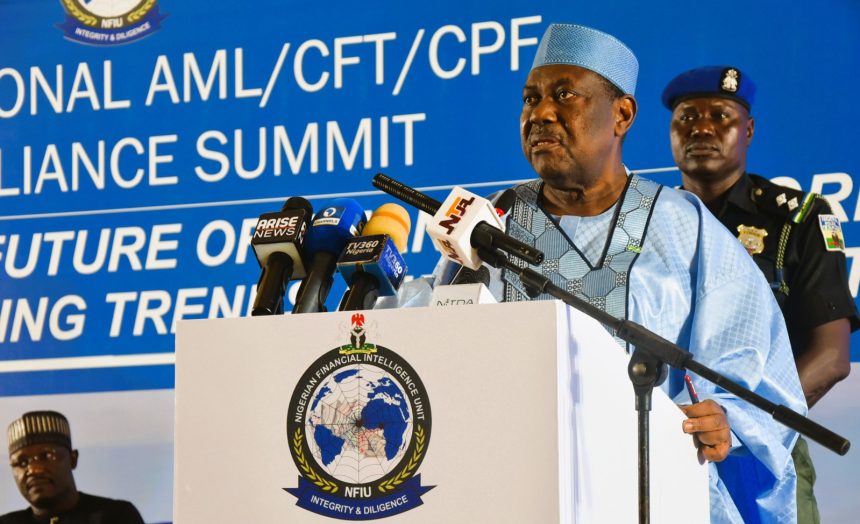
Speaking at the opening session of the 2025 National Anti-Money Laundering, Counter-Financing of Terrorism and Proliferation (AML/CFT/CPF) Summit in Abuja on Tuesday, Senator Akume states that by disrupting the financial networks of terrorist groups like Boko Haram and ISWAP, the government is effectively denying them the resources to carry out their destructive activities.
“By taking away the funds, resources, and material support behind Boko Haram and ISWAP, we are denying them the ability to inflict terror on our communities and citizens,” Senator Akume stated. “We are creating an environment in which our rural areas will thrive once again.”
He stated that this approach of targeting the financial underpinnings of terrorism aligns with global best practices in combating serious crime. The government’s National Strategies to combat serious criminal offenses, including the National Anti-Money Laundering and Counter-Terrorist Financing (AML/CFT) Strategy, the National Anti-Corruption Strategy, and the National Drug Control Master Plan, are all focused on disrupting criminal financial networks.
To enhance the effectiveness of law enforcement agencies, the government has invested significantly in their operations, upgrading their human resources and technical capabilities while ensuring an enabling environment that prioritizes the rule of law and non-interference in their operations. This has resulted in a notable increase in investigations and prosecutions, with a focus on dismantling the entire networks of organized criminal groups.
Senator Akume acknowledged the crucial role of the private sector in the fight against money laundering and terrorist financing. Banks, capital market firms, lawyers, and accountants, as gatekeepers, constitute the first line of defense in protecting the nation’s wealth.
He emphasized the importance of a robust and efficient private sector for economic growth and development, underscoring the critical role of regulatory and supervisory institutions like the Central Bank of Nigeria, the Securities and Exchange Commission, and the National Insurance Commission in ensuring effective supervision of financial institutions.
The SGF reiterated the government’s commitment to completing all items on the Financial Action Task Force (FATF) Action Plan by the May 2025 deadline and exiting the grey list. However, he emphasized that the ultimate goal extends beyond merely fulfilling the action plan. It involves establishing a robust and effective AML/CFT/CPF regime across both the public and private sectors that operates at the highest levels of effectiveness, efficiency, and compliance.
Recognizing the global community’s increasing intolerance of poor corporate behavior and governance, Senator Akume stressed the importance of ensuring that violations of regulations are met with proportionate and dissuasive sanctions, particularly as Nigeria seeks to expand its financial sector internationally.
The SGF commended the Nigerian Financial Intelligence Unit (NFIU) for organizing the summit and for its leadership in strengthening Nigeria’s AML/CFT framework. He also acknowledged the NFIU’s efforts in progressing towards exiting the grey list and its commitment to continuous improvement in AML/CFT compliance.
Hafsat Abubakar Bakari, Chief Executive Officer of the NFIU, emphasized the importance of the 2027 GIABA Mutual Evaluation as an opportunity for Nigeria to demonstrate not only compliance but also leadership in the global fight against financial crimes. She stressed the need to embed a culture of continuous improvement and foster a mindset where compliance is viewed as a foundation for growth and stability.
Deputy Governor, Financial System Stability of the Central Bank of Nigeria (CBN), Philip Ikeazor, highlighted the importance of collaborative efforts and strong leadership to build a resilient and transparent financial system that aligns with global standards. He urged all stakeholders to approach the summit with a sense of urgency and responsibility.