

CBN, NNPC Sign Pact to Keep Oil Dollars Flowing
By Patience Ikpeme
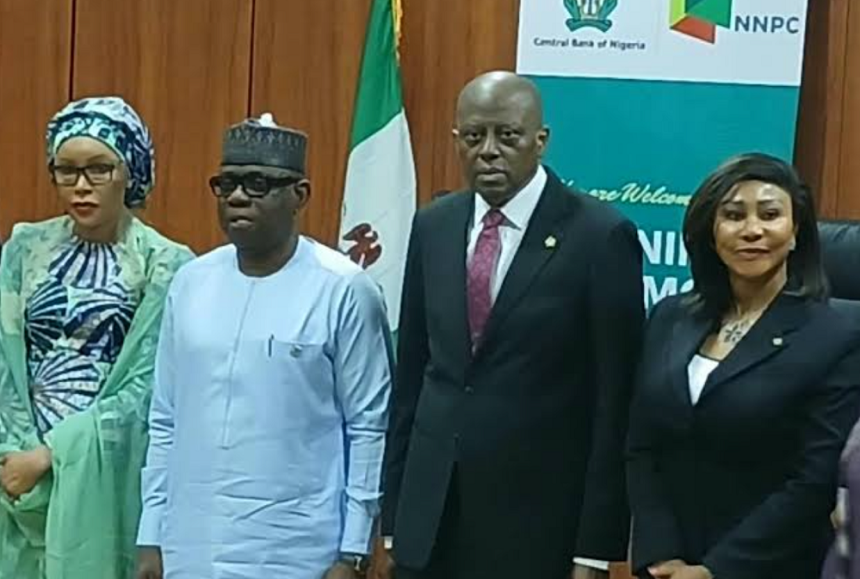
The Central Bank of Nigeria (CBN) says the oil money earned by the Nigerian National Petroleum Company Limited (NNPCL) is a key support for the country’s stability, especially when the foreign exchange market is under pressure. Governor Olayemi Cardoso said this on Wednesday at the signing of a Memorandum of Understanding (MoU) between the central bank and the national oil company.
Mr Cardoso explained that NNPCL’s operations remain “central to Nigeria’s external reserves, fiscal revenue and foreign exchange inflows.” He said the CBN holds NNPCL’s main foreign currency accounts. This puts the bank in charge of making sure oil and gas money is settled on time, safely and openly into the Federation Account and other government accounts.
According to the Governor, working closely together on account management, fund transfers and liquidity support helps the economy because it makes sure money is available for government duties and that dollars come into the foreign exchange market in a predictable way. He said this matters most “during periods of volatility, when dependable flows of oil revenue support monetary stability.”
The Governor also said the CBN will use its power to bring people together to attract big global financial institutions. He said these institutions have the money structures needed to develop Nigeria’s large natural gas resources. This, he said, would add to NNPCL’s own efforts to raise capital.
Mr Cardoso was careful to say the agreement is not a fresh start. “The MoU does not create a new relationship between our institutions,” he said. “The two institutions have worked together for decades.” What is new, he said, is that the long-standing cooperation is now written down. It sets a clear framework for regular meetings, sharing of information and joint action.
He said the areas covered include turning proceeds from oil and gas assets into cash to improve NNPCL’s funding, and faster approvals for the company’s business needs. They also include automated payments and digital tools linking the CBN and NNPCL treasury systems, and a culture of strict compliance and sound risk management. The agreement further covers cybersecurity, including the sharing of threat alerts across the financial and energy sectors, and training for staff of both institutions.
The Governor said the signing should not be seen as a show for cameras. “For us, today is just another day,” he said. “We are simply putting on paper what we have been discussing.” He revealed that NNPCL, some other oil companies and regulators have been meeting every other week to deal with shared problems, and that those meetings have produced results. He added that “we could have done this without the press.”
He said the deal grew naturally and was not something planned only because signing an MoU seemed a good idea. “We got to a point where we felt this was the natural thing to do,” he said. “When economic institutions collaborate in pursuit of a shared vision, the nation benefits, economic stability is strengthened, investor confidence rises.”
Mr Cardoso also praised NNPCL Group Chief Executive Officer, Mr Bayo Ojulari, and his team. “I know what he inherited when he came in, and I know the struggles he has undergone,” he said. He added that “some of the indices we are seeing speak for themselves.”
Speaking next, Mr Ojulari described the state of the company when he took over after the President appointed a new board and management team on April 2, 2025. “Our liquidity position was extremely weak, and the majority of our projects were heavily challenged,” he said. He listed the problems as asset sales that were not well considered, loans that needed restructuring, attempts to borrow more, and troubled refineries. “All these issues, and many more, represented significant leakages in terms of sustainability,” he said.
Mr Ojulari, who spent his whole career in the private sector, called the move one of the hardest of his life. He publicly thanked Mr Cardoso for advice in those early days. “Thank you for your support, mentorship and coaching during those early days when I struggled to stabilise,” he said. He added that some of the company’s successes came from following the Governor’s guidance.
He said the deal reflects a simple truth. “Nigeria’s energy sector and its financial system are not separate stories,” he said. “They are one story.” Since the Petroleum Industry Act turned NNPCL into a limited liability company, he said, it needs “a clear, structured relationship with the country’s monetary authority, built on transparency rather than one-off requests.”
Under the MoU, he said, both sides will work on ways to increase foreign exchange inflows and bring export earnings into the economy. They will also design financing arrangements that help NNPCL raise money “on the strength of its own balance sheet and assets.” The CBN will further help the company improve its compliance and risk systems to the standard it expects of every institution in the financial system.
To make sure the pact does more than look good on paper, a joint steering committee and a joint working committee, co-chaired by both institutions, will track progress against clear performance targets. “We are here not just for the optics,” Mr Ojulari said. “We are here to build a working partnership that delivers results.”
The Governor closed by pledging the CBN’s commitment to sound monetary policy, economic stability, a strong financial system and the long-term prosperity of Nigerians.