

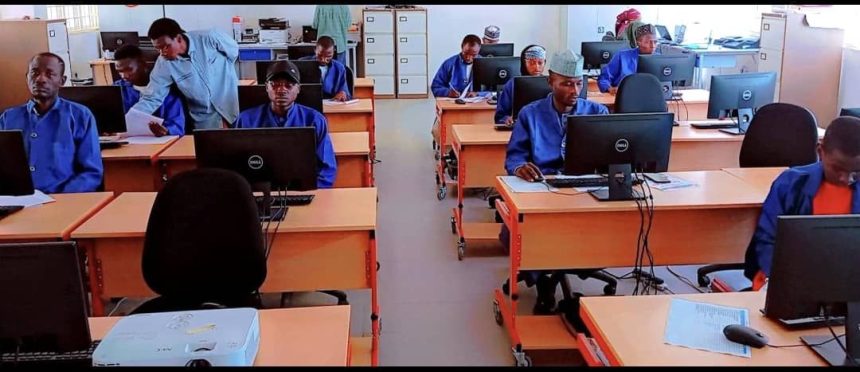
Dangote Foundation Backs Kano Jobs Drive
By Patience Ikpeme

Business leaders in Kano State have thrown their weight behind the Aliko Dangote Foundation’s partnership with the state government to manage the Aliko Dangote Skills Acquisition Centre, saying the initiative could help tackle youth unemployment and provide workers with skills needed by businesses.
The partnership is coming at a time when Kano is seeking practical ways to absorb its large young population into productive economic activities rather than relying mainly on government employment.
Under a Memorandum of Understanding signed with the Kano State Government, the Aliko Dangote Foundation is expected to run the skills centre for several years. The arrangement is expected to give the facility a stronger focus on vocational and other income-generating skills.
Chairman of the Manufacturers Association of Nigeria, Kano-Jigawa Branch, Muhammad Bello Isyaku Umar, said the private sector had an important role to play in preparing young Nigerians for employment and entrepreneurship.
He said the value of the centre would depend largely on whether the training provided matches the changing needs of the economy.
“Skills acquisition is one of the most effective ways of addressing youth unemployment in Nigeria,” Umar said, adding that young people should be exposed to “modern technical, digital and industrial skills.”
He said such training could give beneficiaries different routes into the economy, including starting small businesses, working as skilled artisans or taking up paid employment.
The MAN chief said Kano’s position as a major commercial centre made investment in human capital particularly important, noting that businesses needed a pool of properly trained workers to support industrial and commercial growth.
Umar also drew attention to the wider development work associated with the Dangote Foundation in Kano and other parts of northern Nigeria.
He said the Foundation had supported projects dealing with healthcare, education, water, livelihoods, women’s economic opportunities and assistance to poor communities.
According to him, the significance of such interventions lies in their ability to support public programmes while directing resources towards communities where government intervention alone may not be sufficient.
Umar also acknowledged the relationship between Dangote Industries Limited and MAN, particularly the company’s annual sponsorship of the association’s programmes.
He said such private-sector support was useful to the manufacturing community because it encouraged stronger links between Nigerian-owned businesses, government and large industrial groups.
For the MAN Kano/Jigawa branch, he said, the relationship was also a source of encouragement to its more than 1,000 members in the two states.
Media executive and Managing Director of Radio Kano, Abubakar Adamu, similarly backed the skills initiative, arguing that the scale of Kano’s youth population required a different approach to employment creation.
Adamu said the state could not depend on the expansion of government payrolls to absorb its young population.
“Kano has a huge youthful population, and the state cannot solve unemployment simply by creating more conventional government jobs,” he said.
He argued that training programmes would have greater economic value when they were designed around the skills employers and consumers actually need.
“Young people need skills that correspond to actual market demand,” he added.
Adamu said the Foundation’s activities in Kano also demonstrated the potential of private capital to support development in areas traditionally dominated by government.
He cited its intervention at Murtala Muhammad Specialist Hospital as an example of how cooperation between government and private organisations could strengthen public services.
He also mentioned the Dangote Business School at Bayero University Kano as part of the Foundation’s contribution to education and human-capital development in the state.
The media executive recalled that Kano was also used as a launch point for the Dangote Foundation’s national food support programme in 2025, which was designed to provide assistance to vulnerable Nigerians.
He noted that the Foundation’s micro-grant initiative also began in Kano before being extended to other parts of the country, giving beneficiaries access to financial support for small-scale economic activities.
Adamu further praised Dangote Industries for supporting Radio Kano’s 80th anniversary celebration, describing the gesture as a demonstration of the company’s relationship with the community and its broader responsibilities as a major corporate organisation.
Meanwhile, the skills-development programme is not limited to Kano. The multimillion-naira Aliko Dangote Skills Acquisition Centre at Ganaja in Kogi State has been completed and is awaiting commissioning.
The expansion of the skills initiative comes as unemployment, underemployment and the shortage of job-ready skills remain major concerns for policymakers and businesses across Nigeria.
For Kano, the new management arrangement presents an opportunity to turn a physical skills centre into a more effective pipeline for employment and entrepreneurship.
The success of the partnership will therefore depend on the type of courses offered, the quality of instructors, access to modern equipment and, most importantly, whether graduates can use the skills acquired to secure jobs or establish sustainable businesses.
The backing from the manufacturing and media sectors suggests that the centre is being viewed not simply as another social intervention, but as part of a wider effort to build a workforce capable of supporting Kano’s commercial and industrial economy.